



Introduction to Dyslipidemia
Before you get started with all of the specifics of the ICD-10 Medical Coding System, there is some basic knowledge to be gained regarding dyslipidemia. What is dyslipidemia? Simply put, the term “dyslipidemia” refers to an imbalance of the various types of lipids found in the blood. Similar to the “high cholesterol” commonly referred to in the media, dyslipidemia is a broad category of conditions that include elevated levels of low-density lipoprotein (LDL) cholesterol, reduced levels of high-density lipoprotein (HDL) cholesterol, and elevated levels of triglycerides.
Understanding the clinical relevance of dyslipidemia is just as important as understanding the definition of dyslipidemia. Dyslipidemia is a major factor in cardiovascular disease (CVD). Cardiovascular disease is the leading cause of death in the world. More importantly, cardiovascular disease is a major contributor to morbidity and mortality. Research studies have demonstrated that managing levels of the various types of lipids found in the blood is one of the most effective methods of reducing CVD-related events.
Managing dyslipidemia is only one half of the equation. The other half is accurate ICD-10 coding. ICD-10 coding is utilized by healthcare professionals across the globe to communicate with each other, with payers, and with public health agencies. Accurate ICD-10 coding enables healthcare professionals to accurately identify the type and severity of a patient’s condition, which in turn impacts the type of treatment a patient receives and how a patient’s condition is reimbursed by third-party payers.
Overview of ICD-10 Coding System
While many may see the ICD-10 coding system as complicated to navigate, the International Classification of Diseases, 10th Revision (ICD-10) is a highly valuable tool for communication among healthcare professionals. ICD-10 fulfills several functions: it creates a standardized method of defining diseases; it is the foundation upon which billing is performed; and it assists in the tracking of population health trends.
One of the primary differences between ICD-9 and ICD-10 is that ICD-10 offers much greater specificity for certain conditions, including lipid disorders. Prior to the transition to ICD-10, healthcare providers were unable to adequately differentiate between different types of hyperlipidemia. With the enhanced specificity offered by ICD-10, healthcare providers are able to identify a patient’s exact lipid disorder through laboratory testing results. One advantage of this increased specificity is that it enhances the quality of the data collected on patients, and the second advantage is that it will lead to fewer denied claims due to coding.
ICD-10 Code for Dyslipidemia
Having covered the fundamentals of ICD-10 and dyslipidemia, we can now cover the most commonly used ICD-10 code for dyslipidemia:
E78.5 — Hyperlipidemia, unspecified
When a provider determines that a patient has dyslipidemia or high cholesterol without specifying further, E78.5 is the go-to ICD-10 code for dyslipidemia. Think of E78.5 as the “general bucket.” This is the most frequently used ICD-10 code when a provider documents “dyslipidemia” or “high cholesterol” without providing the specific lipid levels.
Determining when to utilize the unspecified code versus the specific code is a bit challenging. While E78.5 is useful, payers are continually seeking more specificity. For instance, if a patient has elevated LDL and normal triglycerides, utilizing E78.5 would be technically correct but clinically lazy.
The best way to determine whether to choose the specific code or the unspecified code is to follow the clinical documentation guidelines.
Specifically, if you have enough laboratory evidence to establish the specific nature of the lipid disorder, then you should utilize the specific code. Otherwise, the unspecified code should be utilized.
Common ICD-10 Codes for Dyslipidemia
Utilizing the “unspecified” bucket is easier than attempting to move toward specificity. However, the advantages of precision in your lipid disorder coding are substantial. Familiarity with the most common ICD-10 codes for lipid disorders will enhance your ability to accurately code lipid disorders. Below are descriptions of the most frequently encountered ICD-10 codes for lipid disorders:
- 0 — Pure hypercholesterolemia: Utilize this ICD-10 code when the patient’s LDL levels are elevated, however, their triglyceride levels remain within a normal range. This code is used to diagnose pure hypercholesterolemia.
- 1 — Pure hyperglyceridemia: Utilize this ICD-10 code when the patient’s triglyceride levels are elevated, but their cholesterol levels are normal. Hyperglyceridemia is often linked to dietary issues, uncontrolled diabetes, or excessive alcohol intake.
- 2 — Mixed hyperlipidemia: Mixed hyperlipidemia is a common condition characterized by elevated levels of both cholesterol and triglycerides. Utilize this code when the patient demonstrates characteristics of both pure hypercholesterolemia and pure hyperglyceridemia.
- 3 — Hyperchylomicronemia: This is a relatively uncommon form of hyperlipidemia caused by excessive amounts of chylomicrons. Chylomicrons are lipid particles consisting of triglycerides that carry fatty acids from the gut to the liver and adipose tissues. Hyperchylomicronemia is typically the result of a genetic defect or an extreme sensitivity to dietary fats.
- 41 — E78.49 — Other hyperlipidemias: The codes listed above include hyperlipidemias that do not fit into the categories of pure hypercholesterolemia, pure hyperglyceridemia, mixed hyperlipidemia, or hyperchylomicronemia.
- 6 — Lipoprotein deficiency: The opposite of hyperlipidemia, lipoprotein deficiency is a condition in which a person has extremely low levels of lipoproteins. Lipoprotein deficiencies are extremely rare and are usually documented to distinguish them from a patient who has a naturally low lipid profile.
Clinical Documentation Best Practices
Regardless of how proficient you are with the ICD-10 codes and their usage, improper documentation will hinder your ability to correctly code a patient’s diagnosis. Proper clinical documentation is the foundation for ICD-10 compliance.
Proper documentation is crucial for the accurate assignment of ICD-10 codes. Your clinical documentation must support the codes you assign. Therefore, simply stating that a patient has “dyslipidemia” is insufficient. Rather, you should attempt to document the specific type of dyslipidemia diagnosed whenever possible. For example, documenting “Hypertriglyceridemia” instead of “dyslipidemia” when the lab results indicate elevated triglycerides, represents more accurate coding.
Another tactic to assure proper coding is to document the lab results (LDL, HDL, and triglycerides) along with the diagnosis. For example, if you are coding E78.2 (Mixed Hyperlipidemia) and documenting the exact elevations in both values, you remove any ambiguity for the coder and the payer. Documenting the clinical rationale for the treatment plan you prescribed to the patient also aids in decreasing the possibility that a payer will request additional documentation to justify the code you chose.
Additionally, minimizing your dependence on unspecified codes is recommended. If you know that the patient has pure hypercholesterolemia, you should document this. This provides a clearer clinical picture and minimizes the potential that a payer will request additional medical documentation to substantiate the code you elected.
Dyslipidemia Coding and Risk Adjustment
As the focus shifts toward value-based care, the implications of coding extend far beyond obtaining compensation for services provided during the course of the visit to provide an accurate representation of a patient’s long-term health status. This is where risk adjustment comes into play.
Risk adjustment is used by payers to assess the expected cost and complexity of caring for a patient. Within value-based care contracting models, accurate coding of dyslipidemia — particularly when coding with high specificity — contributes significantly to hierarchical condition category (HCC) coding. HCC coding utilizes diagnosis codes to predict a patient’s risk for future medical costs and complexities. Patients with more severe forms of dyslipidemia and comorbidities such as diabetes, hypertension, or obesity represent a higher risk than patients with mild, isolated high cholesterol.
Correct coding in value-based care models is critical. If you are treating a high-risk patient but coding them as “unspecified”, the insurance company assumes that the patient is less ill than they truly are. This can lead to lower risk scores and ultimately lower reimbursement rates for your practice. Accurately documenting the full extent of the patient ensures that you receive the necessary resources to properly manage their care.
Common Coding Errors and How to Avoid Them
Even the most seasoned clinicians and professional coders can trip up when the clinic day gets hectic. However, repeated mistakes in this area can lead to claim denials, audits, and lost revenue. Understanding where the pitfalls lie is the first step toward improving your medical billing accuracy.
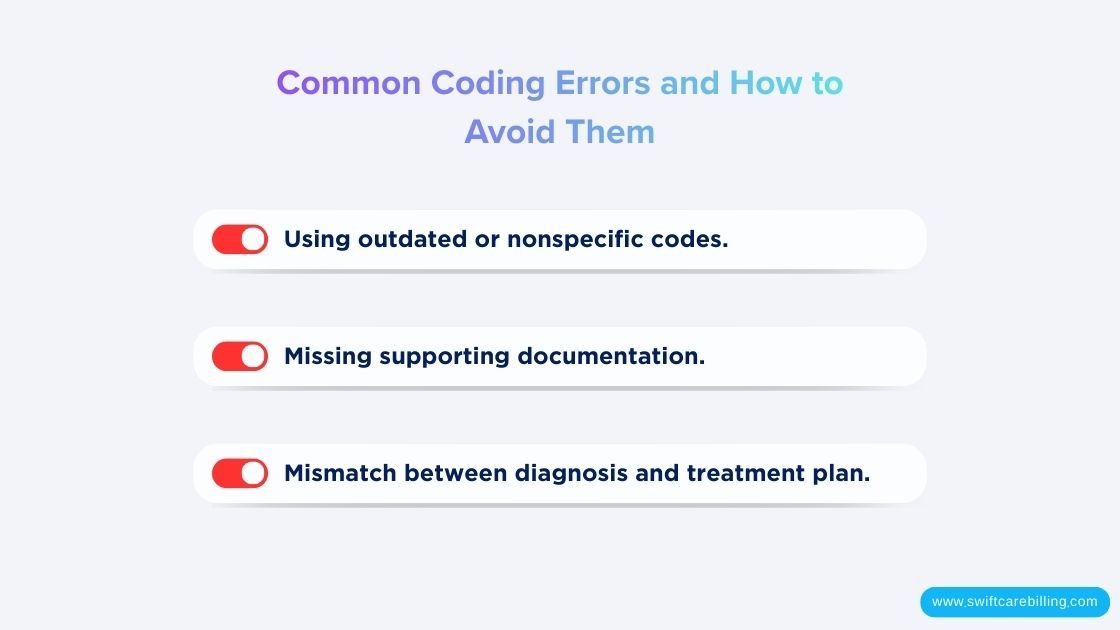
Using outdated or nonspecific codes.
It is easy to fall into the habit of using “E78.5 – Hyperlipidemia, unspecified” as a default because it is quick and universally recognized. However, this is a “lazy” code in the eyes of payers. If your patient has documented pure hypercholesterolemia or mixed hyperlipidemia, using the unspecified code fails to capture the true complexity of their condition. This not only lowers your risk adjustment scores but can also trigger an audit if the payer suspects a lack of specificity.
To avoid this, always ask yourself: “Do I have the lab data to support a more specific code?” If so, use it.
Missing supporting documentation.
A diagnosis code cannot exist in a vacuum; it must be anchored to the medical record. If you code E78.1 (Pure hyperglyceridemia), but there is no mention of triglyceride levels in the progress note or the lab results aren’t attached to the encounter, the code is unjustified. Coders cannot simply “assume” a diagnosis based on history; they need current clinical evidence.
Make it a habit to link the relevant lab values (LDL, HDL, Triglycerides) to your assessment in the note.
Mismatch between diagnosis and treatment plan.
This is a red flag for auditors. For example, if you diagnose a patient with “Hypercholesterolemia” (E78.0) but prescribe a medication primarily indicated for lowering triglycerides without explaining the clinical rationale, it creates confusion. The treatment plan must logically follow the diagnosis. If the clinical picture is mixed, document why you are choosing that specific medication.
Ensuring your plan aligns perfectly with your coding is one of the most effective ways to prevent these common ICD-10 coding errors.
H. ICD-10 Coding Updates and Emerging Trends
Medical coding is a continuously evolving field. Maintaining awareness of updates to ICD-10 is a necessity to remain compliant.
Annually, the Centers for Medicare & Medicaid Services (CMS) modifies ICD-10 slightly to provide more clarity to previously vague definitions and to incorporate new codes.
In addition, the focus is beginning to shift toward ICD-11. Although ICD-11 has not yet been implemented into the U.S. claims system, the direction toward ICD-11 and structured data is unavoidable. ICD-11 is currently under development with the future in mind, enabling more comprehensive documentation and compatibility with contemporary technologies.
Furthermore, the trend is emerging toward greater detail in the categorization of lipid disorders. As researchers continue to discover relationships between genetics and lipid fractions (i.e., Lp(a) or ApoB), coding systems will be compelled to adapt to report these details. Finally, the creation of artificial intelligence (AI) and electronic health records (EHRs) is presenting growing opportunities for automating the coding process. Certain EHR systems are already capable of “reading” lab results and recommending ICD-10 codes to providers. Although this alleviates the cognitive burden of providers, it also enhances the accuracy of the coding process in real-time.
ICD-10 Coding Updates and Future Trends
Medical coding is never static; it evolves alongside our clinical knowledge. Staying ahead of the curve regarding ICD-10 updates is essential for maintaining a compliant practice.
- One of the biggest shifts on the horizon is the transition toward ICD-11 and structured data. While ICD-10 is currently the standard in the US, the healthcare industry is slowly moving toward ICD-11, which is designed for the digital age. This new system allows for much more granular data collection and is built to integrate seamlessly with modern electronic health records. This shift emphasizes “structured data”—information that is standardized and easily searchable—which will eventually allow providers to capture patient complexity with far greater precision than we can today.
- Even before ICD-11 arrives, we are seeing the increasing importance of precise lipid disorder classification. As cardiology advances, we are learning more about lipid sub-fractions (like Lp(a) or ApoB) and genetic markers. Payers are increasingly demanding that providers move away from generic “high cholesterol” diagnoses and classify lipid disorders with high specificity. This precision is vital for personalized medicine, ensuring patients get the right targeted therapies based on the exact type of lipid abnormality they have.
- Technology is also playing a larger role. The role of AI and EHRs in coding accuracy is expanding rapidly. Modern EHR systems are beginning to utilize artificial intelligence to “read” lab results and suggest the most appropriate diagnosis codes to the provider in real-time. This helps reduce the mental load on physicians and minimizes human error. However, these tools are assistants, not replacements. The provider’s clinical judgment remains the final authority, but leveraging these smart tools is a key part of the future of medical coding.
Conclusion
The most important lesson here is that specificity wins.
While the “unspecified” E78.5 code is a valid safety net, relying on it as a crutch does a disservice to your patients and your practice. You should feel empowered to differentiate between pure hypercholesterolemia, hypertriglyceridemia, and mixed hyperlipidemia.
Remember that your documentation is the bridge between the clinical reality you see in the exam room and the administrative record the payer requires. If it isn’t documented clearly in the notes, it effectively didn’t happen in the eyes of an auditor.
Accuracy in coding is more than just a compliance exercise; it is a reflection of the quality of care you provide. Precise coding ensures that the patient’s medical record accurately tells the story of their cardiovascular health. It allows other providers to understand the severity of the condition at a glance and ensures that public health data reflects the true burden of disease.
Furthermore, as we shift toward value-based care, accurate coding is essential for risk adjustment. If you are treating a complex patient with mixed hyperlipidemia and comorbid diabetes, your coding needs to reflect that complexity to ensure your practice receives the appropriate resources and reimbursement.
To keep your practice healthy and compliant, treat coding as a core part of your clinical workflow, not an afterthought. Make a habit of linking your lab results directly to your assessment diagnosis. Audit your own charts occasionally to see if you are defaulting to unspecified codes when specific ones would suffice. By staying detailed and intentional with your documentation, you protect your revenue cycle, reduce the headache of denials, and ultimately provide better, safer care for your patients.
FAQs
What is the most frequently used ICD-10 code for dyslipidemia?
Without a doubt, the most frequently used ICD-10 code for dyslipidemia is E78.5 (Hyperlipidemia, unspecified). This is the general “bucket” code that providers use when they fail to identify the type of lipid disorder.
Can dyslipidemia be coded with cardiovascular disease?
Yes. Dyslipidemia is frequently a co-morbidity that contributes to cardiovascular disease. If the patient has both dyslipidemia and cardiovascular disease and you are treating both conditions, you should code both.
Is dyslipidemia a chronic condition?
Yes. Dyslipidemia is a chronic metabolic disorder that typically requires ongoing management and lifestyle modifications and/or lifetime pharmacologic therapy. Accurately coding dyslipidemia as a chronic condition enables payers to appropriately risk-stratify the patient in value-based care contracts.