
Professional medical billing services in New Jersey (NJ)
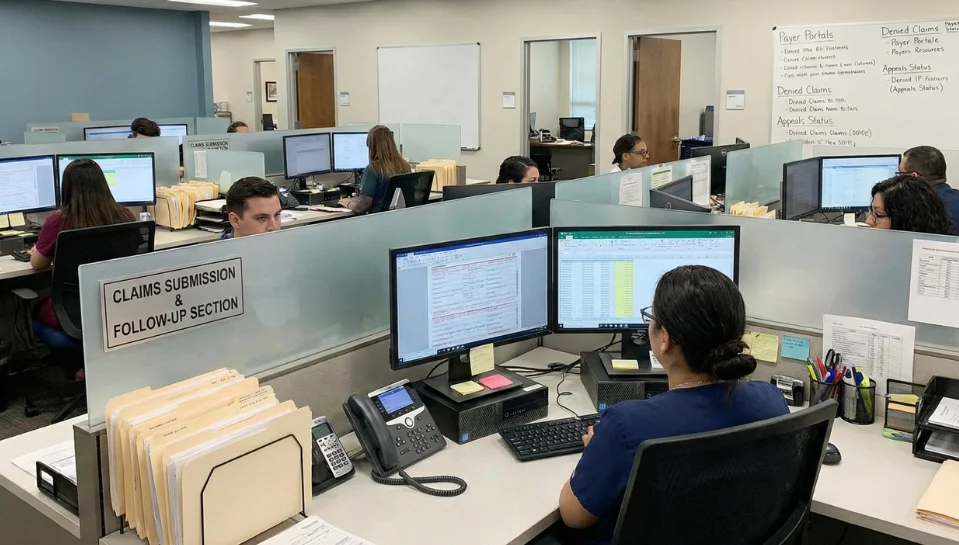
Accurate Medical Billing
Get paid faster
Patient Billing
Predictable cash flow
Our end-to-end medical billing services
Claim scrubbing and submission
Each claim runs through an edit check before it hits the clearinghouse.
The scrubber catches NPI mismatches, missing referring provider, invalid POS, and code pairs that hit an NCCI edit.
Payment posting and reconciliation
We work claims by aging bucket, oldest first, and call the payer instead of waiting on the portal. Every call gets a rep name, a reference number, and a date in the note.
Claims sitting past 90 days pay less often the longer they sit, so timing is the whole job.
Statements show the allowed amount, what insurance paid, and what the patient owes, in that order. We take the billing calls, set up payment plans, and explain why a deductible visit costs more in January.
Your front desk stops fielding questions it was never trained to answer.
Our clients achieve growth
in the RCM cycle.

Who benefits most from our Physician billing services
- Solo and small practices. One biller out sick means claims stop moving. There is no backup.
- New practices. No credentialing, no billing history, no cash cushion while the first claims age out.
- Complex specialties. ABA, behavioral health, oncology, cardiology. More codes, more prior auths, more denials.
- Practices drowning in A/R. Claims past 90 days pile up because nobody has the hours to chase them.
- Practices that just lost a biller. Hiring and training takes months. The claims do not wait.
- Multi-location groups. Different sites, different habits, different results. One process fixes that.
If you have a solid biller, a simple payer mix, and clean numbers, stay put. If any of the above sounds like your week, the math changes.

Get a Free Comprehensive Medical Billing Audit
- 1. You send the data. A claims export from your practice management system, or read-only access for a few days. Ninety days is enough. No contract and nothing to install.
- 2. We run your numbers. First-pass acceptance rate, days in A/R, how much is sitting past 90 days, and your top ten denial codes ranked by dollar value instead of by count.
- 3. We trace each denial to its cause. Coding, eligibility verification, a credentialing gap, a timely filing miss, or a payer rule your system is not flagging before submission.
- 4. We check the payer side. Contracted rates against what you were actually paid, plus any enrollments that are missing, pending, or expired.
- 5. You get a written report in 3 business days. Every finding is ranked by monthly dollar impact, with the specific fix and who needs to do it.

Our affordable medical billing services: what you get for the rate
We charge 3% to 8% of what we collect for you. Where you land depends on your specialty, claim volume, and how much of the work you hand over. Here is what that covers.
One rate, all the work.
Eligibility checks, coding, claim submission, payment posting, denials, follow-up. No extras added later.
Nothing to start.
No setup fee, no onboarding charge, no cost to get your payer enrollments in place.
A real person on your account.
You get a biller who knows your practice by name, not a support inbox.
We fix denials, not just report them.
Your old claims count too.
Unpaid claims sitting from before we started get worked on at the same rate.
No long contract.
Month to month. Leave with 30 days’ notice and take your data with you.
- Domain Expertise
Expert physician billing services built around your specialty
- Nationwide Footprint
A reliable medical billing company for practices across the country.


Why Practices trust SwiftCare billing with their
medical billing services
- 6-provider practice
- Client since September 2023
- 4-provider practice
- Client since November 2024
- 3-provider practice
- Client since March 2024
Certified medical billing specialist on every account
- Certified Professional Biller (CPB), AAPC. Claim submission, payer follow-up, denial appeals, and accounts receivable management across the full revenue cycle.
- Certified Medical Reimbursement Specialist (CMRS), American Medical Billing Association. Insurance claim processing, reimbursement rules, and payer compliance.
- Certified Revenue Cycle Representative (CRCR), Healthcare Financial Management Association. Revenue cycle operations from patient access through claim resolution and payment posting.

Find out what denials are costing your practice
Fill in your details and click Calculate Impact to see your estimate.


Ready to unlock your practice growth? Let’s talk!
Frequently asked questions
How do we know outsourcing is cheaper than our own biller?
Loaded is the part people get wrong. A biller on $70,000 really costs closer to $95,000 once you add payroll taxes, benefits, PTO, and workers’ comp. Then there’s turnover, which runs 30% to 40% a year in billing roles.
Run your number first. Then judge the percentage.
Why charge a percentage instead of a flat monthly fee?
How fast can you start, and what happens to claims already out there?
Claims your current biller already sent keep adjudicating where they were filed. Leave them. What you need is a written cutoff date so nobody’s guessing who owns what, plus an aged AR list before day one.
Watch timely filing. Medicare gives you 12 months from date of service, most commercial plans less. A claim that ages out during a handoff pays nothing.
Who can see our patient data?
Ask any billing company three things, and get the answers in the contract rather than the sales call: where staff sit, whether any work is subcontracted further, and how fast you’d hear about a breach.
Location matters. HIPAA allows PHI to be handled outside the US, but some states restrict it and federal law bars Medicaid payments to entities based abroad.
Do we have to change our EHR?
No. We work in the system you already have.
Any billing company that makes you switch platforms is solving its own problem. Stacking a system migration on top of a billing transition is how practices end up with two months of unbilled charges.
We need user access, clearinghouse setup, and payer portal logins. Read-only is fine for the audit. Your data stays yours either way, and you take it with you in a readable format if you leave.
What will you report, and what should we hold you to?
Here’s what good looks like. Net collection rate above 95%, and below 93% means you’re leaking. First-pass acceptance at 90% or better. Clean claim rate over 95%. Days in AR near 35.
One warning. Collections going up while your net collection rate stays flat means volume grew, not performance. Get your baseline in writing in month one so there’s something to measure against.
If a code is wrong, who's liable?
Outsourcing moves the work, not the liability. That’s why credentials matter, and why it’s worth knowing that billing certifications and coding certifications aren’t the same thing.
Ask what credential the person choosing your CPT and ICD-10 codes holds. Then verify it yourself through the AAPC, AMBA, or HFMA directory.
What do you actually know about New Jersey payers?
On the payer side: Medicare Part B here runs through Novitas Solutions. NJ FamilyCare goes through Horizon NJ Health, Aetna Better Health of New Jersey, Amerigroup, UnitedHealthcare Community Plan, and WellCare, each with its own auth list and appeal path.
Treating “Medicaid” as one payer at check-in is the most expensive habit in a New Jersey front office. Verify the plan, not the program.