


Let’s cut through the hype.
AI in medical billing is just software that learns from your claims data and helps your team do the boring stuff faster. It checks eligibility. It flags coding mistakes. It spots denials before they happen.
It doesn’t replace your billers. It gives them backup.
If you run a practice, you already know billing is messy. Patients, payers, codes, denials. AI won’t fix everything. But it can take a lot off your team’s plate.
Here’s how it really works.
What Does “AI in Medical Billing” Mean?
Short answer: It’s software that looks at patterns in your billing and makes suggestions.
Old billing software only does what you tell it. “If X, then Y.”
AI looks at thousands of past claims and says, “Hey, this claim looks like it will get denied” or “You probably missed a modifier here.”
A human still makes the final call. AI just points out problems earlier.
Where AI Actually Helps in the Billing Workflow?
You don’t need AI for everything. You need it for the parts that slow your team down.
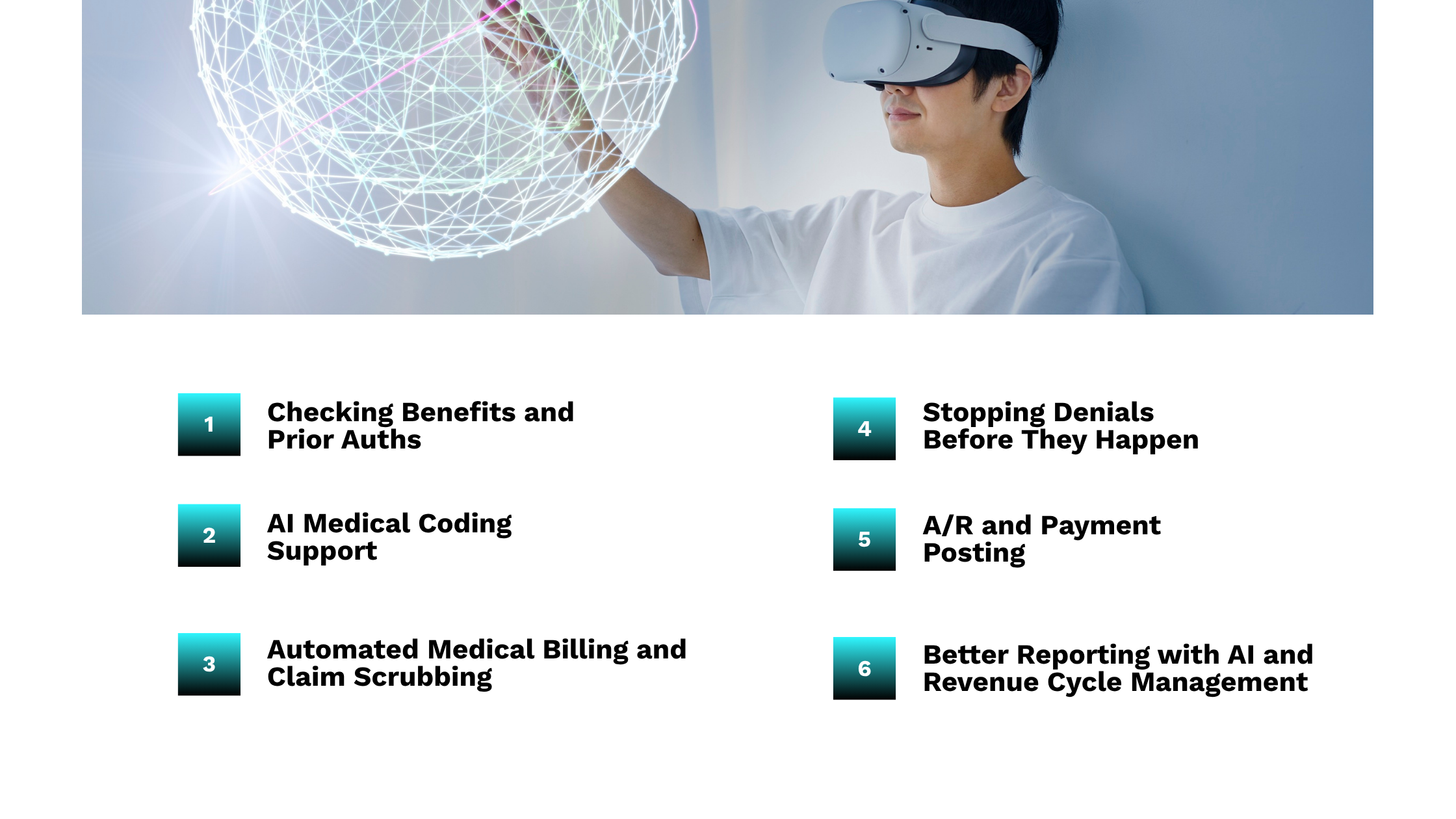
1. Checking Benefits and Prior Auths
Nobody likes calling insurance.
AI tools can pull benefits automatically overnight and flag patients who are missing a prior auth for next week’s visit. That means fewer “sorry, we can’t see you today” moments and fewer denials.
2. AI Medical Coding Support
Family practice notes are a nightmare. Preventive + diabetes + cough all in one visit.
AI medical coding tools read the note and suggest codes. Example: The note says “25 min, MDM moderate, 2 chronic conditions addressed.” The AI suggests 99214 with the right ICD-10s.
Your certified coder still reviews it. But they’re not starting from zero. This saves 30-40% of coding time and catches undercoding.
3. Automated Medical Billing and Claim Scrubbing
Before a claim goes out, AI runs it through hundreds of payer rules.
Missing diagnosis? Wrong modifier -25? Diagnosis doesn’t match procedure? It flags it.
That’s automated medical billing at work. The result is cleaner claims and faster payments.
4. Stopping Denials Before They Happen
This is where AI is actually smart.
It looks at your past denials and learns: “Payer A always denies 99214 without this documentation.”
So when a new claim looks like that, it warns you.
It can also group denials by reason so you can fix the root problem instead of reworking the same denial 20 times.
5. A/R and Payment Posting
AI matches ERAs, finds underpayments, and tells your team: “Work these 30 accounts first. They’re most likely to pay.”
No more guessing where to start.
6. Better Reporting with AI and Revenue Cycle Management
AI and revenue cycle management together means you get answers without digging through reports.
“Why did collections drop last month?”
The AI can point to 1 payer and 1 code that’s causing it.
The Real Benefits You’ll See
I’m not going to say AI will double your revenue. It won’t.
But here’s what practices actually get:
- Fewer denials because errors are caught before submission
- Faster payments because claims are clean the first time
- Less staff burnout because nobody wants to do eligibility all day
- Better coding with AI medical coding support for complex visits
- Clearer numbers so you know where money is leaking
It’s about making your current team more effective.
Where You Still Need Humans
This is important. AI messes up.
You still need people for:
Final coding decisions: A coder has to sign off. That’s an AHIMA/AAPC standard.
Appeals: AI can draft, but a human has to argue why it was medically necessary.
Weird payer rules: AI doesn’t know that Payer B changed their policy last Tuesday unless someone updates it.
Patient calls: No AI can handle “Why is my bill $400?” with empathy.
If you turn AI on and walk away, you’ll have problems. Think of it as a smart assistant, not a replacement.
Compliance and Risks Nobody Talks About
Before you buy anything, ask these:
HIPAA: Does the vendor sign a BAA? Where is patient data stored?
Accuracy: How often is the AI retrained? Payer rules change constantly.
Bias: If it was trained on bad data, it will give bad suggestions. You have to audit it.
Over-reliance: The biggest risk is staff trusting it blindly. That’s how compliance issues start.
AI vs Automation vs Regular Billing Software
Quick breakdown so you don’t get sold nonsense:
| Regular Software | Automation | AI | |
| How it works | You set the rules | Does tasks automatically | Learns and improves |
| Example | Post payments | Send eligibility checks | Predict which claims will deny |
| Updates | You update rules | You update workflows | It updates itself from data |
Most tools today are a mix. Ask what problem it solves, not what buzzwords it uses.
Should You Use AI in Your Practice?
Ask yourself 3 questions:
- Are denials killing your cash flow?
- Are coders and billers overwhelmed?
- Do you have no idea why A/R is aging?
If yes to 2 of those, AI is worth a look.
Don’t start with “AI everything.”
Start with 1 thing. Eligibility or claim scrubbing. Measure it for 60 days. Then decide.
Ask vendors:
- “Show me how this works with our EHR.”
- “Who reviews the AI’s work?”
- “How do you stay compliant?”
What’s Next for AI in Medical Billing?
It’s going to get more proactive.
Imagine AI that flags documentation gaps while the doctor is still in the room. Or predicts what a claim will pay before you even submit it.
But the fundamentals won’t change. You still need good documentation, trained staff, and someone watching the numbers. AI just makes all of that easier.
FAQ
What is AI in medical billing exactly?
It’s software that uses your billing data to automate tasks like eligibility, coding suggestions, claim checks, and denial prediction.
How does AI medical coding work?
The AI reads the doctor’s note and suggests the right codes. A certified coder reviews and approves them. It speeds up coding and improves accuracy.
Will AI replace my billing team?
No. AI handles repetitive work. Your team still handles decisions, appeals, compliance, and patients.
What’s the difference between automated medical billing and AI?
Automation follows set rules. AI learns from data and gets better. Most good tools use both.
Is AI in medical billing HIPAA compliant?
It can be. The vendor must sign a BAA and meet HIPAA security rules.
How does AI help with revenue cycle management?
AI and revenue cycle management together help you find problems faster. Less denials, faster payments, and clearer reports.
What’s the biggest risk?
Trusting it too much and not having humans review the work.
Final Thoughts
Look, billing is hard. Payers change rules. Staff quit. Claims get denied.
AI in medical billing won’t solve all of that. But it can take the busywork off your team so they can focus on the claims that actually need a human.
If you do it right, you get fewer headaches, faster payments, and more time for patients.
That’s the whole point.