


Let me be straight with you.
Most practices don’t lose money because patients don’t pay. They lose money because of billing mistakes.
A wrong digit in a patient’s DOB. A CPT code that’s one number off. A note that forgot to mention wound size.
That’s it. That’s all it takes for insurance to send it back.
And then your biller spends 40 minutes on the phone, resubmits it, waits 3 weeks, and maybe gets paid. Maybe not.
If this sounds familiar, you’re not alone.
How common are medical billing errors? Honestly? Way too common. Industry data says up to 8 out of 10 medical bills have some kind of mistake before they go out. And those mistakes turn into claim denials, delayed cash, and a lot of wasted time.
The frustrating part is most of these are preventable. You don’t need new software. You don’t need to hire 3 more people. You just need to know where the mistakes usually happen and plug those holes.
So let’s talk about it. No jargon. Just real stuff that happens in real practices.
Why Do These Mistakes Keep Happening?
Billing isn’t one person’s job. It’s 4-5 people touching the same claim.
Front desk grabs the insurance card. The nurse rooms the patient. Doctor writes the note. The coder picks the codes. Biller submits it.
If one person misses something, the whole thing falls apart.
And insurance rules? They change constantly. What Medicare accepted last quarter might get denied this quarter. Add prior auth, medical necessity rules, and 15 different payer portals, and it’s a mess.
So yeah, medical billing mistakes happen. But they’re not random. They happen in the same 10-12 places, over and over.
12 Mistakes We See Every Single Week
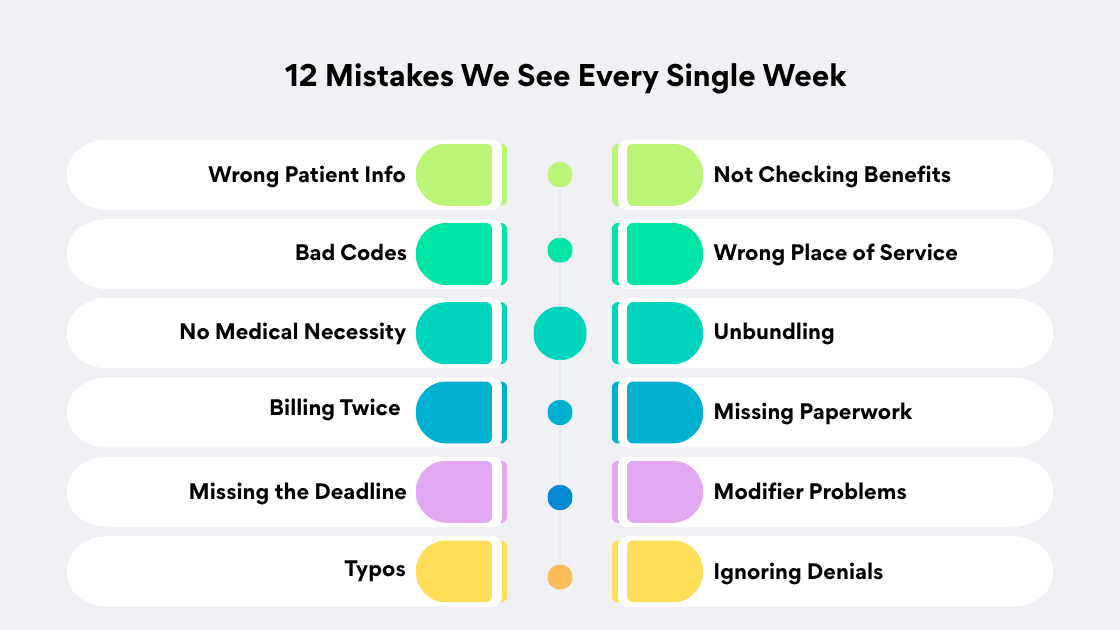
1. Wrong Patient Info
Misspelled name. Old address. Transposed DOB. Wrong member ID.
Payers match everything to their system. If it doesn’t line up exactly, denial.
2. Bad Codes
Using last year’s CPT code. Picking an unspecified ICD-10 when a specific one exists. Forgetting modifier 25 or 59.
In wound care we see this a lot. Billing debridement but not stating the depth. Instant denial.
3. No Medical Necessity
The service was done, but the note doesn’t prove why.
For HBOT, skin substitutes, or MRIs, you have to show other options failed first. If it’s not in the chart, the player assumes it wasn’t needed.
4. Billing Twice
Someone thinks the claim didn’t go through so they send it again. Now you have a duplicate. Both get denied.
5. Missing the Deadline
Medicare gives you 12 months. Most commercial plans give you 90 days. Miss it by a day and it doesn’t matter how perfect the claim is.
6. Not Checking Benefits
The patient had insurance, but not for that service. Or prior auth was needed and no one checked.
This happens all the time at check-in.
7. Wrong Place of Service
Billing POS 11 when it should be POS 22. Hospital outpatient vs. doctor’s office pays differently.
This one trips up wound clinics a lot.
8. Unbundling
Billing each part of a surgery separately instead of using the bundled code.
Payers call this overbilling and deny it.
9. Missing Paperwork
Claim goes out but the chart is empty. No measurements. No signature. No op note.
When the payer asks for records and you can’t send them, you lose.
10. Modifier Problems
Modifier 25 on every E/M visit. Forgetting modifier 59. Wrong bilateral modifier.
Modifiers tell the story. Get them wrong and the story makes no sense.
11. Typos
99214 typed as 99241. 5 units instead of 0.5 units.
Small stuff that stops payment cold.
12. Ignoring Denials
The claim gets denied and sits in a folder for 60 days. Then it’s too late to appeal.
This is where practices bleed the most money.
How Common Are Medical Billing Errors Really?
Let’s answer how common are medical billing errors without sugarcoating it.
Before a claim even goes out, about 30% to 80% of them have at least one error. Most get caught by a scrubber. Some don’t.
After submission, the average denial rate in the US is 5% to 10%. For specialties like wound care, ortho, and radiology, it’s closer to 15% to 20%.
Do the math. If you bill 400 claims a month and 15% get denied, that’s 60 denials.
Each one costs $25 to $100 to rework. That’s $1,500 to $6,000 a month just to fix mistakes.
And that’s not counting the money you never get back because the claim aged out.
So yes, they’re common. But they’re also predictable.
What Denials Actually Cost You?
Claim denials aren’t just an annoyance. They hit you 3 ways.
First, cash flow. You did the work in January and you’re still waiting in April.
Second, your staff. Your best biller spends their day arguing with insurance instead of billing new claims.
Third, patients. They get a bill they shouldn’t have gotten. Now they’re mad and leaving 1-star reviews.
The worst part? Some money is just gone forever. No one appealed. No one followed up.
That’s why prevention matters more than fixing.
Common Medical Billing Errors and Prevention: What We Actually Do
I’m not going to tell you to “leverage synergy” or whatever. Here’s what works in real offices.
You have to start at the front desk. If the insurance info is wrong on day one, nothing you do later will fix it. Scan the card. Verify benefits 2 days before. Ask if anything changed. Check for prior auth right then.
Next, train your providers on documentation. Doctors hate paperwork, I get it. But “wound present” isn’t enough. Payers want length, width, depth, location. For E/M, they want time or MDM. 15 minutes of training a month saves hours of denials.
Then use your software. Turn on claim scrubbers. They’ll catch invalid codes and missing fields before you hit submit. Don’t let the insurance company be your QA department.
Audit yourself. Once a month, pull 20 charts. Do the codes match the notes? Did we get paid what the contract says? You’ll spot problems in 30 minutes.
And finally, track denials. Not just resubmit them. Write down why. Same payer? Same code? Same provider? Patterns tell you where to fix things.
Here are the 5 things that move the needle the most:
- Verify insurance and benefits before the patient arrives and write it down
- Run every claim through a scrubber before submitting
- Teach providers exactly what documentation payers want
- Review denials every week and fix the root cause
- Do a quick monthly audit on coding and payments
Do those and your denial rate will drop. I’ve seen it happen in 60 days.
Some Specialties Get Hit Harder
Billing isn’t the same for everyone.
Wound Care: Missing measurements, wrong debridement depth, messing up skin substitute units.
Primary Care: Billing 99214 when the note only supports 99213.
Radiology: Wrong modifiers for bilateral scans.
Surgery: Forgetting global periods and billing follow-ups separately.
If your specialty has weird rules, you need someone who knows them. A general biller won’t know that NPWT needs specific HCPCS or that HBOT needs documentation of failed treatments.
Building a Process That Doesn’t Leak Money
You’ll never get to 0% denials. Insurance will always find something.
But you can get under 5%. Here’s how.
Make a checklist. Before any claim goes out, confirm 3 things: Is the patient info right? Do the codes match the note? Was eligibility checked?
Give someone ownership. Who is watching AR over 30 days? Who is working denials? If no one owns it, it won’t get done.
Measure 3 numbers: denial rate, days in AR, and first-pass rate. If less than 95% of claims pay on the first try, you have a process problem.
And if you’re drowning, get help. A lot of practices outsource now because it’s impossible to keep up in-house. A good billing team sees what’s getting denied across hundreds of practices. They know what changed last month.
Should You Outsource This?
Not everyone should. But here’s when it makes sense.
If your denial rate is over 10%. If AR over 90 days keeps growing. If your biller quit and you can’t hire. If coding is too complex and mistakes keep happening.
A good billing company won’t just push claims. They’ll find where you’re leaking money and stop it.
They’ll also give you reports you can actually read. Not 40 pages of data. Just: here’s what we billed, here’s what we collected, here’s what got denied and why.
FAQs
How common are medical billing errors?
More than you think. Up to 80% of claims have an error before submission. 5% to 20% get denied depending on your specialty.
What causes the most claim denials?
Wrong patient info and coding errors. But eligibility and missing documentation are right behind.
Can we actually prevent medical billing mistakes?
Yes. Most come from the front desk or coding. Fix those two areas and you’ll prevent most denials.
How much does a denial cost?
$25 to $118 to rework it. Plus the time your staff loses. Plus the delayed payment.
Is outsourcing worth it?
If you’re spending more time fixing denials than billing, yes. It usually pays for itself in 3 months.
Bottom Line
Look, common medical billing errors aren’t because your team is lazy. Billing is hard. The rules are stupid. And they change every month.
But you can get control of it.
Start with the basics. Clean data at check-in. Good documentation. Scrub claims before sending. Track what’s getting denied.
Every claim you fix is money you already earned. You shouldn’t have to fight to get it.
If you want a second set of eyes, SwiftCare Billing does free audits. We’ll look at your last 3 months of denials and tell you exactly where the problems are. No pitch. Just answers.
Get Your Free Billing Assessment