



There is so much reward to working as a mental health professional. You’re helping people navigate the worst moments of their lives.
However, behind all of that clinical work is a complex revenue cycle – probably more complicated than any other specialty in healthcare.
The mental health billing and credentialing process has its own set of guidelines, CPT codes, payer idiosyncrasies and compliance requirements. Any mistakes you make cost you hard dollars and hard time.
This guide will provide behavioral health providers with a comprehensive overview of billing and credentialing for the specialty, from CPT coding rules and documentation requirements to the credentialing process and the most common denial patterns experienced in behavioral health.
Why Mental Health Billing is Different than Medical Billing?
Working in medical billing is vastly different than working in mental health billing. The codes are different, the session structures are timed differently, the auditors for payers have different expectations and the documentation requirements are different in some ways than other specialties.
Understanding the specifics of the differences in the billing process is key to developing solutions.
CPT Codes Used by Behavioral Health Providers
Behavioral health providers primarily use the psychiatric and psychotherapy CPT codes for billing purposes. Below are the most commonly used codes for outpatient behavioral health providers:
- 90791: Diagnostic evaluation of the psychiatric patient without medical services (the typical new patient code)
• 90792: Diagnostic evaluation of the psychiatric patient with medical services (used by psychiatric prescribers who evaluate and manage medications for the patient)
• 90832: 30-minute individual psychotherapy
• 90834: 45-minute individual psychotherapy
• 90837: 60-minute individual psychotherapy
• 90847: Family psychotherapy with the patient present
• 90853: Group psychotherapy
• 99213 and 99214: Evaluation and Management codes used by psychiatric prescribers for medication management visits
The timed nature of the psychotherapy codes is where most billing errors occur. CPT time rules require that the provider document the amount of face-to-face time the patient spent in the session. If a session lasts 38 minutes, the provider should bill the 45-minute code (90834) since CPT time rules require that the provider select the code that most closely represents the documented time. Billing the 60-minute code (90837) for a 38 minute session is an overbilling error and is a frequent pattern identified by audit contractors in behavioral health practices.
Billing Telehealth Services Correctly
Mental health was among the first specialties to rapidly adopt telehealth services and the adoption of telehealth services increased exponentially in 2020 and 2021 due to the COVID-19 pandemic. However, billing telehealth services for mental health requires a thorough understanding of Place of Service codes and modifiers that are specific to each payer.
Currently, Medicare uses Place of Service codes 02 for telehealth services provided outside of the patient’s home and Place of Service 10 for telehealth services provided to the patient in their home. Modifiers 95 or GT depend on the payer requirements. The Place of Service codes and modifiers used for commercial payers vary greatly and many state Medicaid programs have their own unique telehealth billing requirements.
Mental Health Parity: What Does it Mean for Your Revenue Cycle?
The Mental Health Parity and Addiction Equity Act of 2008 requires insurance plans that cover mental health and substance use disorders to provide coverage on the same terms as medical and surgical services. In practice, this means payers must follow strict rules when handling behavioral health claims, making mental health billing more closely monitored.
For your revenue cycle, parity is straightforward. Insurers cannot impose limits on mental health services that they wouldn’t apply to comparable medical services. For instance, if a plan offers unlimited physical therapy visits, it cannot restrict outpatient psychotherapy to 20 visits per year. Likewise, if cardiology referrals do not require prior authorization, psychiatry visits generally shouldn’t either.
Even after 15 years, parity violations remain common. In 2023, the Department of Labor found nearly all insurers examined applied treatment limitations that unfairly restricted mental health benefits. Many prior authorization and coverage issues you encounter may be parity violations, and both patients and providers can dispute these through formal appeals.
Billing staff can use parity knowledge strategically. Documenting and challenging patterns where insurers treat mental health claims differently from medical claims can help protect revenue and ensure compliance.
Behavioral Health Credentialing: Why It Takes Longer
Credentialing is the process that payers utilize to verify a provider’s qualifications, licensure, malpractice history and practice information and formally enrolls the provider as an in-network provider. For behavioral health providers, the credentialing process is often longer and more complex than in other specialties. Understanding why this is true is helpful in planning and preparing for the credentialing process.
- First, many commercial payers enforce network adequacy caps on mental health providers in specific geographic regions. When a payer determines that their network of psychiatrists or therapists in a particular area is adequate, they may close their panel to new applicants. Therefore, a provider could submit a completed, accurate application and still be informed that the panel is closed. This occurs more frequently in behavioral health than in most other specialties.
- Second, behavioral health encompasses a wider variety of provider types than most fields. Payers credential psychiatrists, psychologists, licensed clinical social workers, licensed professional counselors, licensed marriage and family therapists, and certified addiction counselors, often through different processes and under different criteria, even within the same insurance company.
- Third, primary source verification for behavioral health licenses requires communication with state licensing boards and those boards respond to verification requests at varying speeds.
Types of Providers That Must Have Separate Credentialing Processes
Not every clinician in your practice will credential the same. Identifying the type of provider that must be credentialled and the level at which they must be credentialled is essential to developing and implementing your revenue cycle plan accurately.
Prescribing Psychiatrists (MDs and DOs)
Credentialed as physicians.
The most common credentialing process, however, the process is still subject to the constraints of mental health network panels.
Psychologists (PhD and PsyD)
Credentialed as separate entities from physicians. Most major payers have a separate behavioral health network for doctoral level psychologists.
Licensed Clinical Social Workers (LCSWs)
Credentialled individually by most major commercial payers. Active state licensure and documentation of supervised hours are generally required.
Licensed Professional Counselors (LPCs) and Licensed Marriage and Family Therapists (LMFTs):
The credentialing requirements vary based upon the payer and the state in which the practitioner is licensed. Some payers credential these practitioners and others do not credential them.
Psychiatric Nurse Practitioners (PMHNPs):
Credentialed as mid-level providers. Requirements for collaborative agreements and scope of practice vary by state and must be investigated prior to submitting credentialing applications.
Having a valid state license does not automatically guarantee that a payer will credential the provider. State licensure and payer credentialing are two completely separate processes that have their own respective requirements. New therapists and counselors frequently assume that their license is sufficient to allow them to bill insurance and learn otherwise when their first claims are denied for lack of valid provider status.
Maintaining a Complete and Up-To-Date CAQH Profile?
CAQH ProView is a database utilized by most commercial payers to obtain credentialing data for their providers.
CAQH is a single location where providers can input and update their professional information, including education, training, licensure, malpractice insurance and employment history.
Payers rely on CAQH data during the credentialing process instead of requesting additional credentialing data from the provider.
Updating and maintaining a complete and current CAQH profile is not optional for timely credentialing.
Incomplete or outdated CAQH data is one of the most consistent factors contributing to delays in credentialing applications and/or rejection of applications. Providers are required to re-attest to their CAQH profile every 120 days.
Additionally, providers are required to upload their active malpractice certificates, active state licenses and active DEA certificates in the CAQH database. Failing to perform this task results in unnecessary delay in credentialing applications submitted to payers.
Most Common Reasons Claims Are Denied In Behavioral Health
Behavioral health billing and credentialing have their own set of trends. There are some reasons for denied claims that apply to all specialties. There are also many that apply only to mental health. These are the denial areas your billing team must be actively monitoring and managing.
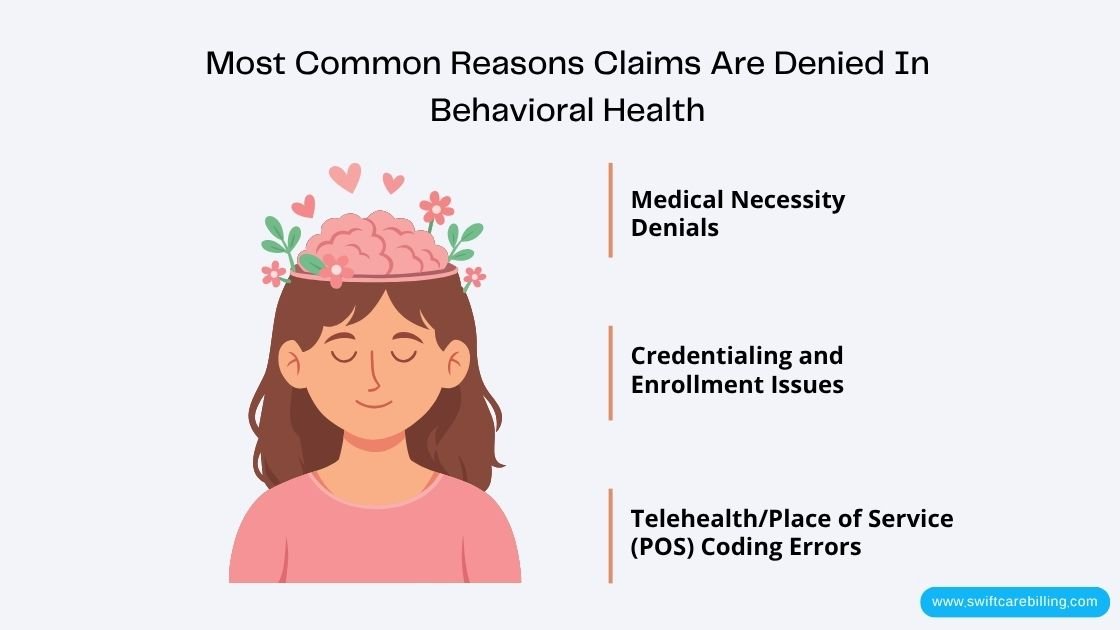
Medical Necessity Denials
The most common reason for denied claims in mental health are based on medical necessity.
Medical necessity is evaluated by comparing clinical documentation to established criteria such as InterQual, Milliman Care Guidelines, or payer-specific criteria.
Documentation in clinical notes must support the level of care billed. A claim for intensive outpatient services requires documentation that supports the patient’s presentation meets the criteria for that level of care.
Vague or copied forward notes that do not provide evidence of the patient’s symptoms, level of functional impairment, and treatment response will continue to cause medical necessity denials in behavioral health.
Payers are looking for clinical assessments made individually for each patient.
Templated notes that are the same session after session are a warning sign for any behavioral health audit.
Credentialing and Enrollment Issues
Any services provided prior to a provider being fully credentialed and having an active effective date with a payer will be denied.
This is due to a lack of retroactive credentialing and is very common when a new clinician is hired into a practice. Very few payers will allow retroactive billing for dates of service prior to the effective date of credentialing.
A small number of payers may allow for a short period of retroactive billing if requested; however, this is not standard.
The solution to this issue is to begin the credentialing process for new clinicians as soon as possible, preferably prior to their start date as a clinician.
If there is a delay between the time a clinician begins treating patients and when they are fully credentialed, verify if the services could be billed under the NPI of the supervising provider with applicable supervision billing rules.
Telehealth/Place of Service (POS) Coding Errors
With telehealth becoming a permanent option for delivering behavioral health, billing POS 11 (office) for a video session is a very common error that most payers will identify and deny. It is essential to ensure your billing team verifies the delivery method for each session prior to submitting a claim.
Final Thoughts
You can’t treat mental health billing and credentialing casually and expect good results.
The rules are specific, compliance risks are real, and complexities keep growing as telehealth expands, parity enforcement increases, and Medicaid coverage changes affect behavioral health nationwide.
Whether you handle revenue cycle management in-house or work with a specialized billing and credentialing firm, the core principles are the same.
Get credentialed with the right payers before seeing patients. Submit claims with complete and accurate documentation every time. Actively manage denials instead of ignoring them.
Practices that follow these steps consistently maintain financial stability while delivering the care patients need.
| Are you struggling with Credentialing? Get Credentialed with Payers Quickly and Receive Your Payments Fasters Swiftcare Billing is a USA Based RCM and Medical Credentialing Providers that aligns your requirements with insurance payers. We help Mental Health Practices Verify their Credentials without any delay. |