



A busy ABA clinic can look healthy on paper: full caseload, steady authorizations coming in, strong clinical team, and consistent session volume.
Then the money tells a different story.
Claims get denied. Payments come in lower than expected. A/R ages out. The practice starts “working denials” harder, but the gap doesn’t close. This usually isn’t one big mistake. It’s small ABA billing errors that stack up across three pressure points:
- Units (what was delivered vs what was billed vs what was paid)
- Authorizations (what was approved vs what was actually provided over time)
- Payer Edits (how payers adjudicate, reduce, bundle, or cap what you submit)
This guide shows how those three areas cause claim denials and underpayments, and the most common mistakes. You’ll also learn simple changes to turn your patient care into reliable revenue.
Why A Full ABA Schedule Doesn’t Guarantee Stable Revenue
The simplest way to understand ABA revenue leakage is to stop asking, “How many sessions did we run?” and start asking, “How many payable units did we actually produce?”
ABA is unusually vulnerable because so much of reimbursement depends on these things:
- Time-based codes and unit conversion (often billed in 15-minute units)
- Role + service rules (technician-delivered protocol vs QHP protocol modification, “direction” vs “supervision”)
- Strict ABA prior authorization controls that can drift out of sync with scheduling within days or weeks
- Payer adjudication logic (edits, caps, and reductions that don’t always show as a “claim denial”)
That combination means a clinic can deliver great care and still “lose money” through billing mechanics.
Time-Based Unit Errors That Quietly Destroy ABA Practice Revenue
Most ABA owners don’t wake up thinking “unit conversion.” They just know the clinic ran sessions and expected payment.
But many ABA codes are billed as units of time, and payers apply rules to what they consider payable. CMS also uses unit caps like Medically Unlikely Edits (MUEs) to reduce improper payments.
Delivered Minutes ≠ Billed Units ≠ Paid Units
A common pattern looks like this:
- The session runs “about two hours.”
- The note is completed later with rough start and end times.
- Billing converts minutes to units.
- The payer adjudicates and reduces units, flags overlap, or caps the daily max.
If you don’t audit the paid units, you never see the leak.
The Unit Loss Patterns ABA Clinics See Most Often
Here are the high-frequency “silent killers”:
- Partial sessions and rounding habits
A consistent 5–10 minute loss across multiple sessions per day can materially lower billable units over a month. Many 97153 guides emphasize accurate time capture because it’s billed in 15-minute increments. - Late starts and early pickups
Your schedule shows two hours. The delivered time shows 1:44. That “small” difference may drop a unit. - Gaps between sessions
Clinics often assume “a 2–4 hour block” is billable. Billing often isn’t that forgiving. - Overlap and concurrency conflicts
When a technician session and a supervising/protocol-modifying service overlap in a way the payer doesn’t allow, adjudication can reduce one side or both. Some payer FAQs explicitly discuss concurrent billing scenarios and expectations.
The Role and Code Confusion That Causes Denials
ABA therapy is role-sensitive:
- 97153 is commonly described as technician-delivered adaptive behavior treatment by protocol under supervision.
- 97155 is adaptive behavior treatment with protocol modification by a physician/QHP and may include simultaneous direction of a technician.
The ABA Coding Coalition also clarifies concepts like “direction” vs “supervision” in the context of 97155.
Practical Fix:
Build a simple “Who Can Bill What” chart for your clinic. Make it part of onboarding for clinical and admin staff. Update it when payer rules change. Contact us if you want us to help you make the chart for your ABA practice.
Authorization Drift: The ABA Billing Problem That Starts In Scheduling
Most clinics treat prior authorization as an admin task: “Get auth, then treat.” In reality, authorization is a living constraint. It can drift out of sync with real-world delivery quickly. SwiftCare Billing offers ABA prior authorization and billing services because this is a major failure zone in ABA RCM.
What Authorization Drift Looks Like In Real Life
Authorization drift happens when:
- The clinic’s schedule keeps running,
- But the authorization unit balance, service type, provider level, or date window no longer matches what’s being delivered.
Common scenarios:
- Unit depletion without alerts
Many payers don’t proactively warn clinics when units are close to exhaustion. That creates accidental delivery of unauthorized hours, followed by denials. - Authorization date window mismatch
Services delivered outside authorized dates are often denied automatically. - Mismatch in provider type
Authorization may specify a provider level or service type that doesn’t match the rendering provider. - Retro corrections and overlapping authorizations
Retroactive updates are where “clean care” becomes “dirty billing,” and write-offs happen because the clinic can’t cleanly rebill within timely filing limits.
Authorization Controls That Actually Prevent Denials
If you want authorization drift to stop, you need controls, not reminders:
- Weekly authorization reconciliation
Compare scheduled hours vs authorized remaining units every week (not monthly). - Hard stop rules inside scheduling
No “just add them in” without confirming the auth validity for that date and provider level. - A single source of truth
If your EHR has one number and the billing spreadsheet has another, drift is guaranteed. - Renewal lead time policy
Start renewal workflows early enough that sessions don’t fall into the “pending” gap.
Payer Edits And Adjudication: Where “Paid” Still Means “Paid Short”
Payer adjudication is the process by which the insurer reviews the claim and decides whether to pay, deny, or adjust it. This is where a lot of ABA revenue breaks silently, because the clinic sees a payment and assumes the claim is fine.
Why Underpayments Are Harder Than Denials
Denials get attention because they’re loud.
Underpayments hide because:
- the claim status says “paid,”
- but units or the allowed amount are reduced,
- and no one compares the payment to the expected reimbursement.
The only reliable way to catch this is to read your remittances (ERAs) with discipline.
CMS explains that Claim Adjustment Reason Codes (CARCs) and Remittance Advice Remark Codes (RARCs) communicate why payments differ from charges and can be used to interpret payer adjustments.
The ABA Payer Edit Patterns That Cause “Paid Short”
Here are the common buckets:
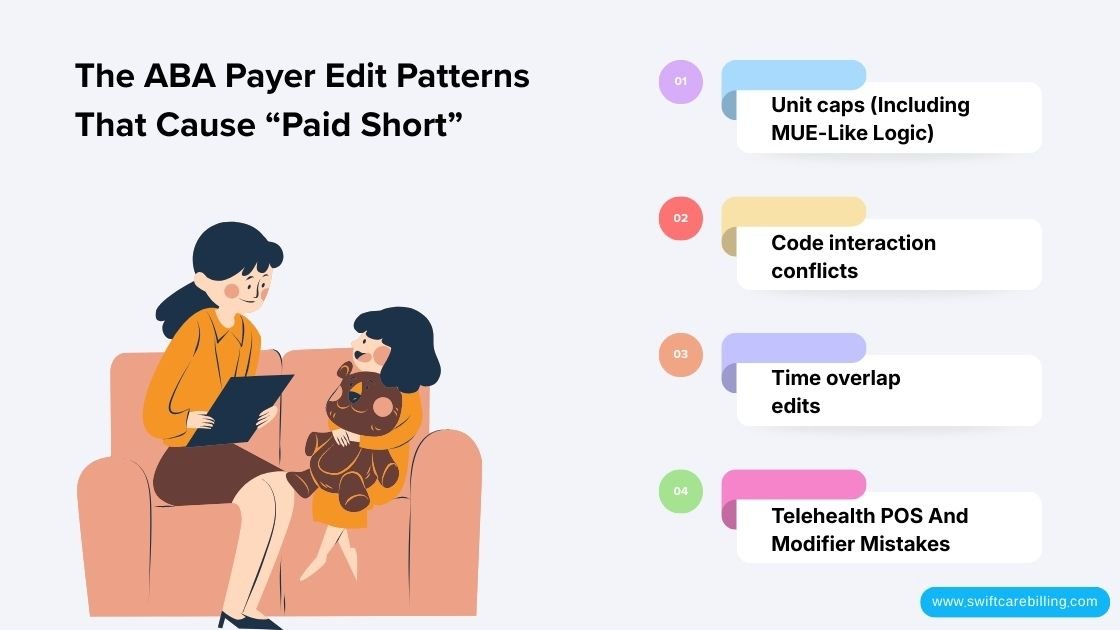
- Unit caps (Including MUE-Like Logic)
CMS describes MUEs as maximum units of service for a code on a date of service, used to reduce improper payments. Commercial payers often apply similar caps, even when they don’t call them MUEs. - Code interaction conflicts
When codes overlap or violate payer-specific bundling rules, adjudication may reduce or deny part of the claim. (This is where general medical billing knowledge is not enough.) - Time overlap edits
If services overlap in a way that the payer doesn’t allow, you may lose units or see reductions. - Telehealth POS And Modifier Mistakes
Even when telehealth is allowed, wrong POS/modifier combinations can cause denials or nonpayment. CMS defines POS 02 (telehealth other than home) and provides broader telehealth guidance. Some payer billing guides are explicit that telehealth claims require POS 02 or POS 10, and POS 11 is incorrect for telehealth.
Practical Fix:
Build a payer-by-payer rules sheet for:
- POS codes
- telehealth modifiers
- concurrency allowances
- daily unit caps
- documentation thresholds
SwiftCare Billing’s claim edits guide can help your team understand edits as “gatekeepers” and how to prevent denials before submission.
ABA Modifier, Credentialing, and Rendering Provider Mistakes That Trigger Denials
Many ABA denials are not “clinical” at all. Their identity and formatting failures:
- wrong rendering provider,
- missing/incorrect modifier,
- credentialing mismatch for location,
- or payer enrollment not aligned to how services are delivered.
ABA’s role structure makes this easier to mess up than most specialties.
The Most Common Provider-Identity Failures
- Rendering vs supervising provider mismatch
Your clinical reality might be “BCBA directed care,” but the claim needs to match payer rules for who is the rendering provider for that CPT code. - Multi-location credentialing gaps
Providers credentialed at one site may not be credentialed at another. Claims can be denied even when the service is legitimate. - Incorrect modifier usage
Modifiers can be payer-specific. “Works for one payer” can still fail for another. ABA billing resources regularly warn that modifiers and payer rules must align for reimbursement.
Practical Fix:
Create a “Claim Identity Checklist” before submission:
- Patient demographics verified
- Policy active for DOS
- Correct payer order (COB)
- Correct rendering provider NPI for that code
- Correct place of service
- Correct modifier set for that payer
- Authorization attached and valid
Why ABA Denial Reports Don’t Show The Real Problem
Most denial dashboards are too shallow to solve ABA revenue leakage.
They might show:
- denial rate,
- top denial reasons,
- total A/R.
But they don’t show:
- unit reductions,
- authorization drift,
- paid-but-short patterns,
- operational workflow that created the error
So clinics respond by pushing claims harder instead of fixing the process that generates bad claims.
The Upstream Failures That Create Downstream Denials
These are the root causes that keep showing up across ABA billing error research:
- Eligibility not fully verified at intake (active plan ≠ ABA coverage confirmed)
- Documentation timing gaps (notes completed late, missing key details)
- Coding based on habit instead of a rule (codes used without checking payer requirements)
- Submission delays that violate timely filing (a “perfect claim” still denies if filed late)
Important Compliance Note:
ABA billing is under scrutiny in multiple states and Medicaid programs. And federal and state agencies have flagged questionable billing patterns and improper payments in ABA. That makes accuracy and documentation more than a cash-flow issue.
The Financial Indicators That Prove Revenue Leakage Is Happening
If you only track “denial rate,” you miss the silent half of the problem. Use these metrics to detect unit loss, authorization drift, and adjudication reductions early:
ABA Revenue Per Hour (Or Revenue Per Session)
If clinical hours are stable but revenue per hour trends down, you’re likely seeing:
- unit loss,
- underpayments,
- or increased reductions.
ABA Reduction Rate (Paid-But-Short)
Define it simply:
- Reduction Rate = % of claims paid with a unit or allowed-amount reduction
This forces your team to look at ERAs, not just claim status.
CMS notes that CARCs/RARCs explain payment adjustments, which is exactly what you need to analyze reductions systematically.
ABA Denial Clustering By Payer, Code, and Location
Denials become solvable when you can answer:
- Which payer?
- Which CPT code?
- Which location?
- Which rendering provider?
- Which authorization pattern?
That’s how you distinguish a training issue from a payer policy issue.
ABA A/R Aging That Doesn’t Match Your Story
If you’re “busy and growing” but:
- A/R over 60–90 days increases,
- cash flow becomes unpredictable,
- staff spend more time on rework,
You’re not scaling. You’re accumulating billing friction.
Evaluating Specialized ABA Billing As A Financial Control Strategy
Many clinics ask, “Should we outsource ABA billing?” A better question is:
Do we have the systems and expertise to control unit accuracy, authorization alignment, and payer edits at scale?
Generalist billing teams often do fine in “simple” specialties. ABA is not simple. Rules vary by payer, codes are time-based, authorizations change frequently, and role-based documentation matters.
What Specialized ABA Billing Changes In Practice
A strong ABA billing partner typically adds controls like:
- Authorization surveillance (prevent drift before it becomes a denial wave)
- Unit integrity checks (minutes → units → payer caps)
- Claim edit management before submission
- ERA-level underpayment detection using CARC/RARC logic
- Denial prevention + appeals workflow rather than only “denial cleanup.”
If you’re in comparison mode, SwiftCare’s roundup of ABA billing companies can help you evaluate options.
A Simple Checklist To Prevent ABA Claim Denials And Underpayments
Use this as a weekly operator checklist. It’s short on purpose.
ABA Unit Controls
- Are start/end times captured accurately for every session?
- Do billed units match delivered minutes after conversion?
- Are paid units audited against billed units for top payers?
ABA Authorization Controls
- Do we reconcile remaining authorized units weekly?
- Do we have a hard stop rule when authorization is invalid or exhausted?
- Do scheduling and billing share the same “source of truth”?
ABA Payer Edit Controls
- Do we track the reduction rate separately from the denial rate?
- Are telehealth POS/modifier rules enforced per payer?
- Do we audit CARC/RARC patterns monthly to identify new payer behaviors?
ABA Documentation Controls
- Do notes support medical necessity and match billed time and service?
- Are notes completed within an internal deadline (not “whenever”)?
- Are provider roles and services clearly documented to support the chosen code?
Closing: The Goal Is Not More Billing Work. It’s Less Revenue Leakage.
ABA billing errors don’t just delay cash flow. They create ongoing rework, staff frustration, and compliance exposure.
The fastest path to stable revenue is to treat billing like a control system:
- Units are measured, not guessed.
- Authorizations are monitored, not assumed.
- Payer edits are anticipated, not discovered after underpayment.
If you want SwiftCare Billing’s most relevant next steps, start with the ABA billing services overview. And if you have some questions, speak to our ABA RCM specialist.