



If you’ve ever received a claim payment that felt “short” without explanation — chances are, an offset has hit you. It’s one of those billing headaches that sneaks in quietly and leaves you wondering where your money went.
Offsets aren’t new, but they’ve become more common as payers tighten compliance rules and audit payments more aggressively. Whether you’re running a private practice or managing hospital billing, understanding offsets — and how to handle them — can protect your bottom line.
Let’s understand offset in medical billing, why they happen, and what you can do to prevent them.
What Is an Offset in Medical Billing?
In simple terms, an offset is when an insurance company deducts money from a new claim payment to recover an amount previously overpaid.
So instead of sending you the full reimbursement for the current claim, the payer withholds part or all of it to “offset” a past balance you owe them.
Think of it like this:
You owed the payer $150 from a past overpayment. Now they owe you $400 for a new claim. They’ll pay you only $250, keeping the $150 to settle the previous balance.
It’s not the same as a denial — the service was approved and processed — but you didn’t get the full amount.
Why Do Offsets Happen?
Offsets usually happen when there’s an overpayment in your previous claims. That overpayment might be due to:
Duplicate Payments
The payer accidentally pays the same claim twice. When they catch it later, they recover it by offsetting your future payment.
Coordination of Benefits (COB) Errors
If the patient has multiple insurances and billing wasn’t done in the correct order, one payer might claw back what they believe was incorrectly paid.
Post-Payment Audits
Insurers regularly review paid claims and identify errors — such as incorrect codes, missing documentation, or unbundled procedures — and recover the overpaid amount through offsets.
Eligibility or Coverage Issues
If the patient was ineligible or the service wasn’t covered, the payer might first pay but later retract once they verify the mistake.
Provider Contract Adjustments
Sometimes, contract updates or new fee schedules result in retroactive payment corrections, which can lead to offsets.
How Offsets Work in Medical Billing?
Let’s say a clinic submitted a $500 claim. The payer mistakenly paid $700.
A month later, the payer identifies the $200 overpayment and flags it for recovery. Instead of sending a refund request, they automatically apply an offset when the clinic’s next claim of $600 is processed.
So instead of getting $600, she receives $400, and the $200 is used to offset the previous overpayment.
It’s a silent deduction — often leaving practices confused until they check the ERA (Electronic Remittance Advice) or EOB.
How to Identify Offsets on EOBs or ERAs
Offsets aren’t always labeled clearly. But if you read your ERA carefully, you’ll spot them using these clues:
- CARC 23 – “Payment adjusted due to prior overpayment.”
- CARC 94 – “Processed in accordance with Federal/State balance billing limitations.”
- RARC N807 – “Offset applied to an overpayment.”
You’ll typically see a negative adjustment or remark that mentions “recoupment,” “recovery,” or “offset.”
Pro tip: Always reconcile payments using your ERA reports and post them correctly in your billing software. Missing an offset can mess up your A/R balance and make your financial reports inaccurate.
Types of Offsets in Medical Billing
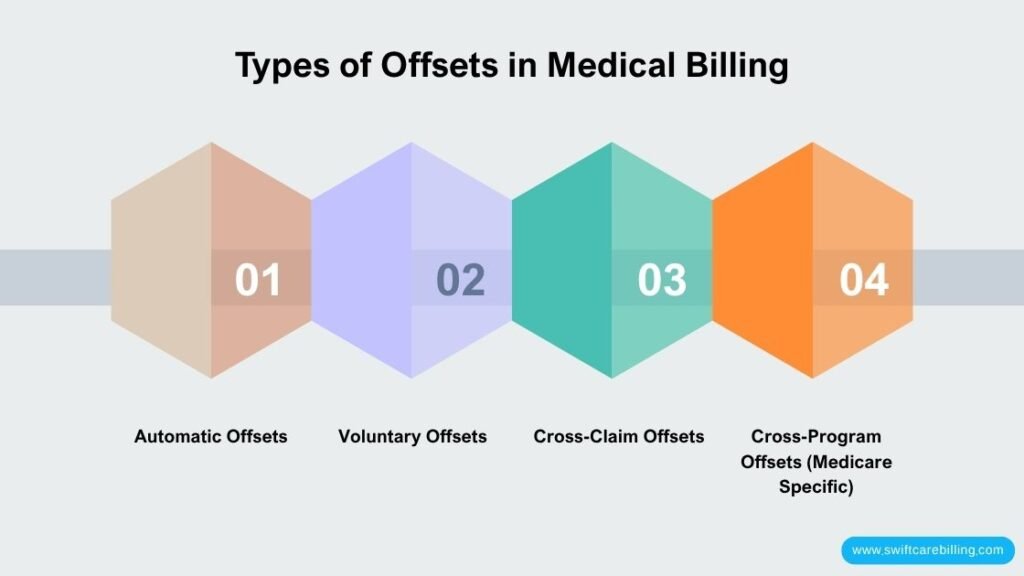
Not all offsets are the same. They are present in different forms. Here are some major types of offsets in medical billing:
Automatic Offsets
Payers apply these automatically without notifying you first. Familiar with Medicare and some commercial insurers.
Voluntary Offsets
When you identify an overpayment, you request that the payer deduct it from future payments rather than issue a refund.
Cross-Claim Offsets
Used when multiple claims from the same provider are pending. The payer adjusts one claim’s payment against another’s overpayment.
Cross-Program Offsets (Medicare Specific)
Medicare contractors can recover overpayments from different program types — for example, offsetting a Part B overpayment using future Part A payments.
Medicare and Medicaid Rules for Offsets
Offsets are tightly regulated, especially under Medicare and Medicaid.
Medicare
- Medicare allows contractors to initiate an offset 40 days after issuing an overpayment demand letter if you haven’t refunded or appealed.
- You can request an extended repayment plan (ERP) to avoid large offsets if cash flow is tight.
- Recoupments show up as “Offset” on your Medicare Remittance Advice.
Medicaid
Medicaid varies by state, but most programs follow similar rules:
- Providers get written notice before offsets are applied.
- You can appeal or request a refund plan.
- Some Medicaid MCOs (Managed Care Organizations) offset automatically through their portals.
Tip: Always check your state’s Medicaid provider manual for specific offset procedures.
Offset vs. Recoupment: Are They the Same?
They’re related but not identical.
- Recoupment means the payer is recovering an overpaid amount — that’s the process in a nutshell.
- Offset is how they do it — by deducting from future payments.
So, every offset is a recoupment, but not every recoupment happens through offset. Sometimes, you’ll be asked to send a refund check instead.
How to Handle an Offset
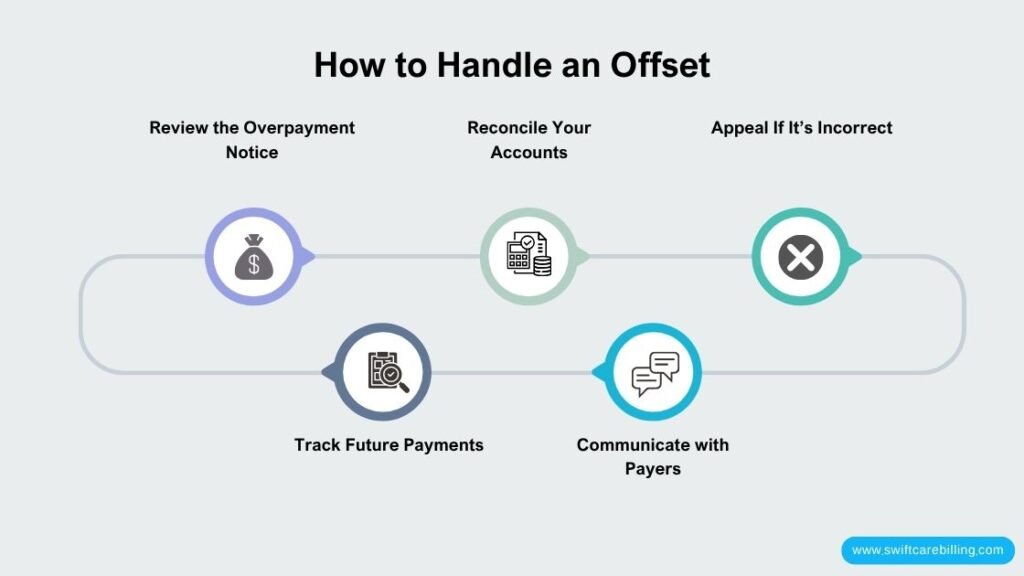
Offsets can disrupt your cash flow, so handling them correctly is crucial. Here are some best practices for handling them.
Review the Overpayment Notice
Always verify the payer’s explanation.
- Was the claim truly overpaid?
- Is the amount correct?
- Did they follow proper notification timelines?
Reconcile Your Accounts
Match the offset amount in your ERA/EOB with the payer’s notice. Adjust your billing software to reflect the correction so your A/R stays accurate.
Appeal If It’s Incorrect
If you believe the offset was unjustified, file an appeal.
Attach:
- The original claim
- Supporting documentation
- Proof of medical necessity
- EOBs or prior authorizations
Track Future Payments
Keep an eye on future ERAs — payers sometimes spread offsets across multiple payments, making it hard to detect.
Communicate with Payers
If the offset impacts multiple claims, call your payer’s provider relations or recovery department. Request a recoupment summary to understand which claims were affected.
How to Offset in the First Place
Here’s where good billing hygiene saves the day. Prevention always beats chasing corrections.
- Strengthen Coding Accuracy: Most offsets start from incorrect coding. Regularly audit claims and use coding tools to verify CPT/ICD accuracy before submission.
- Verify Eligibility Every Time: Many overpayments stem from ineligible patients. Automate real-time eligibility checks to catch inactive policies before they become a problem.
- Double-Check COB Information: When patients have multiple coverage plans, always confirm the primary and secondary insurance correctly to avoid payer mix-ups.
- Maintain Clean Documentation: Keep notes, encounter forms, and procedure records tight. If an auditor reviews your claim, you’ll have solid proof to defend your payment.
- Respond to Overpayment Notices Promptly: If you receive a notice, act quickly — repay or dispute it before it is automatically offset.
- Train Your Billing Team: Keep your staff up to date on payer offset and recoupment policies. One missed notice can trigger a long chain of deductions.
Offset Recovery and Refund Process
When an overpayment is confirmed, payers usually give providers two options:
- Refund the amount manually (by check or EFT).
- Authorize offset from future claims.
If you do nothing within their timeline, they’ll automatically offset.
Example:
- The payer sends a $300 overpayment notice on August 1.
- You don’t respond by September 10.
- They automatically offset $300 from your next payment.
Financial Impact of Offsets
Offsets might seem minor, but repeated deductions can disrupt cash flow and distort revenue forecasts.
Let’s say your practice averages $100,000 in monthly reimbursements. Even a 3% offset rate ($3,000 per month) equals $36,000 in lost or delayed revenue annually — not a small number for any clinic.
That’s why tracking and managing offsets is a crucial part of revenue cycle management (RCM).
To Minimize Offset Risks
- Keep a recoupment log in your billing system.
- Assign one team member to monitor overpayment letters and offset notices.
- Audit 10–15 claims every month for accuracy.
- Use RCM software that automatically flags payment discrepancies.
- Reconcile every ERA before closing your monthly books.
Legal and Compliance Considerations
The Affordable Care Act (ACA) and CMS regulations require providers to return identified overpayments within 60 days of discovery, or it may be considered a False Claims Act violation.
That’s why offsets aren’t just a financial issue — they’re also a compliance risk.
Always document all offset communications and refund actions to protect your practice during audits.
Conclusion
Offsets can quietly eat into your practice’s revenue if you don’t monitor them closely. Understanding how they work—and setting up a solid prevention and tracking system—helps you stay in control of your payments.
The goal isn’t to eliminate offsets (some are unavoidable), but to reduce surprises, maintain cash flow stability, and ensure transparency in your billing records.
Stay proactive: review your ERAs, communicate with payers, and train your billing team. A little diligence goes a long way in keeping your revenue intact.
Partner With Swiftcare Billing Today And See How Smarter Billing Management Can Protect Your Revenue.
At Swiftcare Billing Services, we help healthcare providers track, manage, and prevent offsets with advanced RCM tools, audit checks, and real-time payer reconciliation.
- Identify overpayments early
- Prevent unwanted recoupments
- Maintain clean financial reporting
- Improve cash flow stability