



Medical billing outsourcing involves taking the services of professional third-party billers to clear medical bills, which comprise coding, claims submission, and collections.
This approach helps practitioners to focus on patients and reduce administrative burdens. The demand for outsourcing medical billing is increasing day by day and is expected to reach around $18.7 billion by 2034. In 2024, the demand was $5.9B, according to the Precedence Research report. This demand has increased now in 2025 due to increasing claim denials and challenges in in-house billing. According to the MGMA research, the shortcomings of in-house billing have led 36% practices to outsource medical billing in 2025.
Medical billing outsourcing is a smart option for all practices, but the particular practices like small practitioners urgently need these services. Small practices usually have a limited budget, and in-house billing costs more as compared to outsourcing, which is why this is a good option for them.
Quickly Growing Medical Billing Businesses:
Practices that are adding providers need to outsource medical billing for scalable support.
Multi-Specialty Medical Centers: Multi-specialty clinics need complex coding that becomes difficult to achieve in-house and requires an expert medical billing company.
Overloaded Staff: Healthcare practices with heavy patient loads can offload billing tasks by outsourcing billing to avoid burnout.
Practices Prefer Medical Billing Outsourcing for Financial Betterment
Practices prefer medical billing outsourcing when it comes to handling billing tasks, as in-house billers have certain limitations.
Lack of technical staff:
Hiring certified billers and retaining them, especially for small practices, is difficult compared to outsourcing medical billing, as it gives quick access to experienced professionals.
Excessive Administrative Workload: An industry report shows that 61% of providers plan to outsource medical billing services because medical billing tasks such as insurance verification and compliance audit takes time that affect patient care.
Regulatory changes and Coding Challenges: Updates on ICD-10 codes, regulatory changes, and complex coding standards create constant compliance pressure. Outsourcing medical billing companies stay updated on laws like HIPPA and ICD-10 to assist practices avoid penalties.
Lack of Latest Knowledge and Technology: In-house billing teams lack hi-tech knowledge, while medical billing companies hire certified coders and use advanced software to manage complex tasks.
Top Benefits of Outsourcing Medical Billing Services:
I am writing here top benefits of outsourcing medical billing services to make outsourcing decision easier for you.
Outsourcing medical billing offers healthcare providers a strategic advantage that goes beyond simple cost savings.
Accurate and Increased Reimbursements:
By entrusting your billing processes to specialized professionals, you gain access to a team with deep expertise in navigating complex insurance regulations and ever-changing compliance requirements. This not only reduces the risk of costly errors but also ensures faster, more accurate reimbursements.
Use of Advanced Technology and Software:
Additionally, outsourcing partners often utilize advanced technology and software to streamline claims processing, minimize denials, and provide transparent reporting.
Improve cash flow:
Ultimately, by outsourcing medical billing services, practices can improve cash flow, reduce overhead costs associated with hiring and training staff, and stay ahead in an increasingly competitive healthcare landscape. It’s a smart solution for practices seeking efficiency, accuracy, and peace of mind.
Reduce costs:
By using outsourced medical billing, practices cut operational costs up to 30 to 40% and ensure regulatory compliance.
Medical Billing Outsourcing Company Selection Procedure:
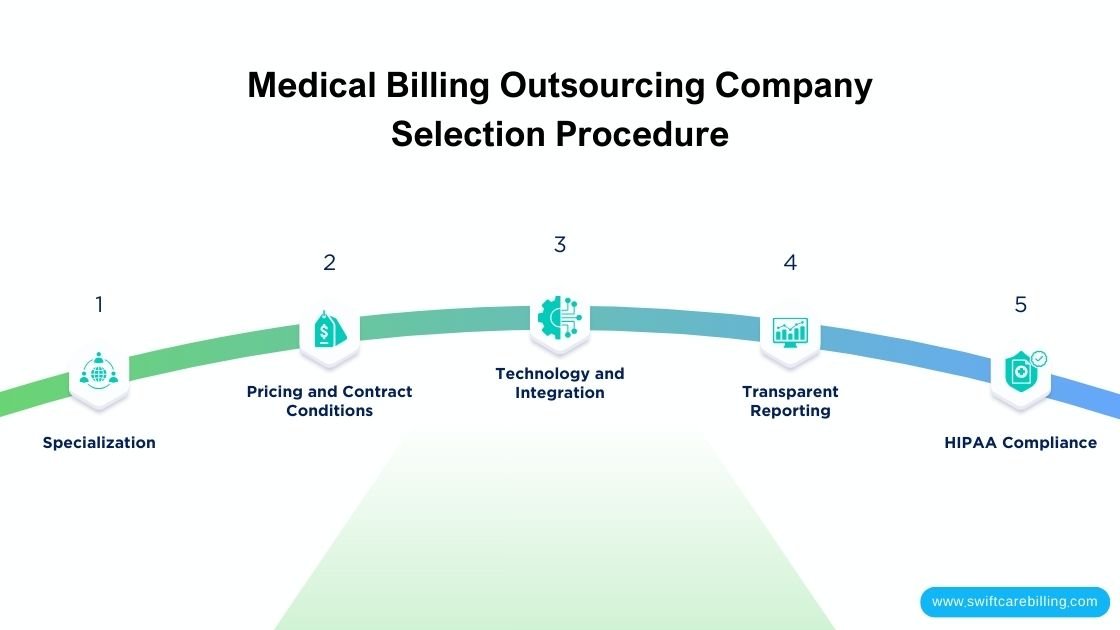
Finding the Perfect medical billing company is essential to achieve your targeted goals. Below are few points to find it out.
Specialization: Choose the medical billing company that is experienced in your specialty and suits with your size.
Pricing and Contract Conditions:
Practitioners need to understand and agree with mutual agreement on percentage or per claim fees. Both parties need to discuss further if they have any queries or doubts.
Technology and Integration:
Healthcare providers need to make sure that medical billing outsourcing team offers updated tools and they can integrate with your EHR. Also ask about custom integrations and their use of automation such as AI and RPA bots for a seamless workflow.
Transparent Reporting:
The outsourced medical billing company is bound to provide clear financial reports and KPIs that include collections, denials and AR days. These reports must be provided after some particular time frame to monitor performance.
HIPAA Compliance: Make sure that the provider is HIPAA certified and uses strong cybersecurity. Also, they have processes for data encryption, breach response, and compliance training.
Pricing Model that Suit Practices When Outsourcing Medical Billing:
Outsourced billing services providers typically use one of several pricing models:
- Percentage of collections
- Flat fee per claim
- Hybrid approach
The vendor charges a set rate (often 4 to 10%) of the actual income they get under a percentage-based arrangement. A flat-fee model, on the other hand, charges a predetermined sum for every claim or interaction. Hybrid models combine the two, providing a different rate for each claim and a different rate for specific claims.
According to industry research, percentage models are widely used and frequently cost-effective for activities. Outsourcing costs typically account for 5% of collections, according to MGMA. Incentives from the outsourced billing provider are now in line with the practice. Because it scales with your revenue and encourages our medical billing outsourcing team to maximize reimbursements, our percentage model is generally preferred.
Welcome Call: Medical billing company’s manager schedules a meeting to answer your questions and set expectations for the task given to them.
2. Complete Documentation: After that, you will fill out a structured form that includes information on your locations, EHR systems, and areas of expertise. Additionally, in order to provide our outsourced billing staff with the appropriate context, your practice must provide the provider roster and existing workflows.
3. Onboarding Meeting: Your employees will need to provide secure access to your EHR and billing platforms during a live session, which is typically conducted by video conference. Both parties will go over the data transfer procedures during this virtual meeting.
4. Creating Workflow SOPs:
Our professionals create personalized SOPs that outline each phase of your revenue cycle, from charge capture to rejection management, based on your feedback.
5. Starting Date: Once testing is complete and SOPs are approved, a mutually agreed is set. On this date, outsourcing company formally takes over your billing operations, with real time reporting kicking in immediately.
Conclusion
In summary, outsourcing medical billing can transform a practice’s revenue cycle. By handing billing and coding efficiently, providers reduce costs and unlock more time for patient care. We’ve covered why medical billing outsourcing is growing, its benefits, and best practices.
Ultimately, the right partner makes all the difference. For example, SwiftCare Billing company stands out with its comprehensive RCM service and commitment to data-driven results. Practices that choose proven outsourcing firms like Connecticut report faster claim turnaround and improve cash flow.