



In-Network Providers:
Practitioners, hospitals, and doctors that have contract with insurance company are known as in-network providers. Members of insurance companies are preferred to see in-network providers. The insurance company pays for these costs. The patient will pay only the remaining amount, such as co-pay or a portion of the deductible.
Out of Network Providers:
Out-of-network providers do not have a contract with the insurance provide when a patient visits an out-of-network physician, their insurance may only pay a portion of the bill or none at all. Patients frequently wind up paying significantly more out of pocket because there is no negotiated cost.
Handling Medical Claims
Medical claim processing is the procedure by which a healthcare provider submits a claim to a patient’s health insurance company in order to be compensated for the services rendered. Processing medical claims has an impact on your practice’s cash flow, payment schedules, and even patient happiness.
Several crucial steps are involved in the entire process:
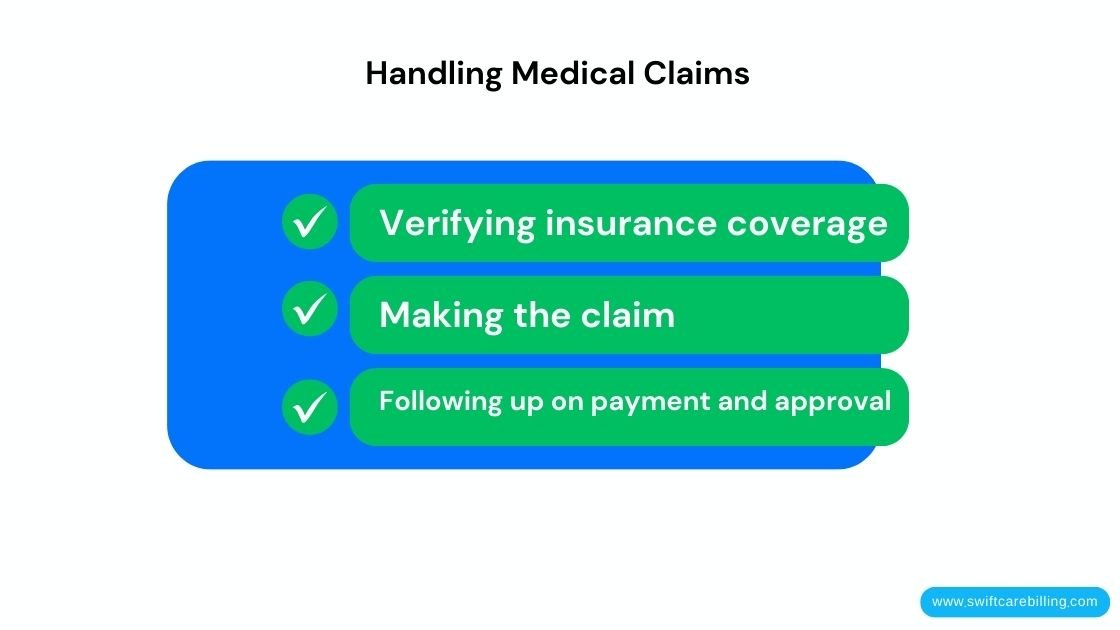
- Verifying insurance coverage
- Making the claim
- Following up on payment and approval
The crucial element is that each of these processes varies depending on whether you are an in-network or out-of-network provider.
Processing of In-Network Claims
Handling In-network claims is easier and quick because the provider and insurance company already have a contract. The staff confirms the patient’s insurance coverage before appointment and submits the claim to the insurance provider following the visit.
In accordance with the terms of the contract, the insurance provider handles the claim. They typically pay between 80% and 90% of the authorized sum if the service is covered. The remaining amount, typically a copay or coinsurance, is subsequently paid by the patient.
The terms are straightforward, so you’ll get the money sooner. Additionally, the patient’s out-of-pocket expenses are typically reduced because of the pre-negotiated lower prices.
Processing Out-of-Network Claims
Medical claim processing for out-of-network physicians might be more difficult for both your patient and your practice. Patients’ out-of-pocket expenses are frequently significantly greater because there is no contract with the insurance company, making payments less predictable.
This is how the procedure typically operates:
Out of network benefits differ greatly and some insurance plans provide little or no reimbursement for out-of-network services, others do not cover them at all. It frequently takes longer for the insurance company to pay. Sometimes the patient receives the reimbursement cheque instead of your practice. Your office will have to wait until the patient pays you if that occurs. Additionally, the patient may be liable for 100% of the cost if the insurance rejects coverage.
The Distinction between an Out-Of-Network and In-Network Reimbursement
Reimbursement rates, patient responsibility, the claims submission process, and the possibility of claim denial or delay are some of the major areas where the claim processing process for in-network and out-of-network providers may differ. The amount that in-network and out-of-network providers are paid—as well as the amount that patients ultimately pay—is one of the main distinctions between them.
In-Network Compensation
The insurance company and in-network providers have prearranged reimbursement rates. These prices are typically less than what the provider typically charges. The benefit is that claims are processed more easily and are paid more quickly.
The insurance company is already aware of the precise rate they have agreed to pay you when you file a claim as an in-network provider. This result in faster payment and fewer delays.
Patients gain as well. In the form of copays or coinsurance, they typically only cover a small portion of the entire bill—roughly 20%.
Out-of-Network Compensation
Conversely, there is no formal contract between the insurance company and out-of-network providers. Therefore, the insurance company determines what it deems “reasonable” for the service when they file a claim. It is frequently predicated on a typical and customary rate.
The patient’s out-of-pocket expenses increase as a result (usually between 40% and 60% of the overall price). Additionally, payment to your clinic can be delayed or, in certain situations, paid straight to the patient.
Selecting an in-network provider is more cost-effective since the patient will pay a smaller portion of the overall service cost. However, choosing out-of-network care typically entails greater costs, which is crucial to keep in mind while budgeting for medical costs.
Electronic Claims for Quicker Handling
The majority of in-network providers file claims via computerized systems. Compared to manual paperwork, this expedites the procedure and lowers the possibility of errors. The provider provides the necessary procedure codes, diagnosis codes, and cost information when filing a claim.
Automated systems are used by insurance companies to quickly validate this information, determine the patient’s eligibility, and determine the payment amount.
Professional Billing Assistance
In-network providers frequently collaborate with third-party billing firms or seasoned billing teams. These groups are aware of the precise actions that each insurer demands. This knowledge reduces the possibility of claim denials or delays brought on by incomplete data.
Quicker Payment and Fewer Problems
Payments arrive more quickly as a result of this efficient procedure. The patient simply has to pay their copay or deductible; the insurance company pays its portion immediately. There are fewer billing conflicts and speedier answers when concerns do arise because everything is outlined in advance.
The procedure of submitting claims for out-of-network providers is frequently less predictable, more complicated, and slower. They have no formal contract with the insurance company, in contrast to in-network providers. Both the patient and the clinician experience uncertainty and additional work as a result of this disagreement.
Manual Submission and Additional Documentation
A lot of out-of-network claims need to be filed by hand. However, some insurers do accept electronic claims. Manual submissions necessitate filling out comprehensive forms, such as:
- Codes for services
- Details about the diagnosis
- Information about the patient
The insurer may postpone or reject the claim if any portion of it is erroneous or incomplete, requiring the provider to submit it again with the necessary adjustments.
Extra Documentation Is Frequently Needed
Insurance companies frequently want additional documentation from out-of-network providers. These could consist of:
A declaration of medical need
An itemized bill with extra information describing the course of treatment
These records support the need for the care and the affordability of the expense. Nevertheless, obtaining and submitting this data may cause the approval of claims to take longer.
Extended Evaluation and Reduced Compensation
Insurance companies typically examine claims more closely when there is no prior agreement. They might contest the choice of treatment, the medical necessity, or even the amount that was billed. As a result, reimbursement rates are lower and processing times are longer.
Sometimes the insurance provider rejects all or a portion of the claim.
The patient pays first, then requests reimbursement.
Patients frequently have to pay the entire amount up front before submitting a claim for reimbursement. However, out-of-network coverage typically only pays a tiny fraction, which is determined by the insurer’s internal policy rather than the amount billed by the provider.
This procedure may result in:
- Delays in payments
- Denials of claims
- An increased cost to the patient
Concluding Remarks
Processing claims within a network is typically quicker and simpler. The reason for this is that providers and the insurance company have a contract.. As a result, patients pay less out of pocket and physicians receive payment more quickly.
However, the process is more difficult for out-of-network providers. Payments take longer because there isn’t a formal agreement. Patients frequently pay extra, and reimbursement rates can vary. Additionally, many claims require additional documentation, which slows down the process.