



In the complex world of healthcare revenue cycle management, AR follow-up stands as one of the most critical yet often ignored functions. While submitting claims correctly is important, the real challenge begins when those claims encounter delays, denials, or partial payments. Effective AR follow-up can mean the difference between a thriving practice and one struggling with cash flow issues.
Understanding Accounts Receivable Follow-Up
Accounts receivable follow-up is the systematic process of tracking outstanding insurance claims and patient balances to ensure timely payment. It involves monitoring claim status, investigating unpaid or underpaid claims, resolving denials, resubmitting corrected claims, and pursuing patient payments. This process begins the moment a claim is submitted and continues until full payment is received or the account is regarded uncollectible.
The importance of AR follow-up cannot be overstated. Healthcare providers deliver services with the expectation of payment, but the complexity of insurance billing means that clean claim submission doesn’t guarantee prompt reimbursement. Claims can be unpaid in payer systems due to processing backlogs, get denied for various reasons, or be paid incorrectly. Without diligent follow-up, these unpaid claims accumulate, creating a mounting accounts receivable balance that threatens the financial stability of medical practices.
The AR Aging Report: Your Roadmap to Collections
The foundation of effective AR follow-up is the accounts receivable aging report, a financial snapshot that categorizes outstanding balances by how long they’ve been unpaid. Typically divided into aging buckets of zero to thirty days, thirty-one to sixty days, sixty-one to ninety days, ninety-one to one hundred twenty days, and over one hundred twenty days, this report provides crucial insights into collection efficiency.
Claims in the zero-to-thirty-day category are relatively fresh and often still within normal processing timeframes. However, once claims cross into the thirty-one-to-sixty-day range, they require active follow-up. The sixty-one-to-ninety-day bucket represents a warning zone where collection becomes increasingly difficult, while claims beyond ninety days face diminishing recovery prospects and may require escalated efforts.
Industry benchmarks suggest that the majority of a practice’s accounts receivable should fall within the zero-to-thirty-day range. When aging reports show significant balances in older buckets, it signals systemic issues requiring immediate attention, whether related to claim submission quality, inadequate follow-up resources, or problematic payer relationships.
The AR Follow-Up Process
Effective AR follow-up follows a structured approach that combines technology, strategy, and persistence.
The process begins with claim status monitoring. Billing staff regularly check on submitted claims through payer portals, clearinghouse reports, or electronic remittance advice documents. This monitoring identifies claims that remain unpaid beyond expected processing times, typically fifteen to thirty days for electronic submissions.
When a claim requires follow-up, staff initiate contact with the insurance payer. This may involve calling the payer’s provider services line, submitting online inquiries through payer portals, or sending written correspondence. During these interactions, billing representatives gather critical information about claim status, reasons for any delays or denials, and specific actions required to resolve issues.
Documentation of all follow-up activities is essential. Each contact should be recorded in the practice management system with details including the date, person contacted, information obtained, and next steps planned. This documentation creates an audit trail, prevents duplicate efforts, and ensures continuity when different staff members handle subsequent follow-up on the same account.
For denied claims, the follow-up process involves analyzing the denial reason, determining whether it’s correctable, gathering any additional documentation needed, and either resubmitting the claim with corrections or filing an appeal. Some denials result from simple clerical errors that can be quickly fixed, while others require extensive documentation or clinical justification to overturn.
Patient follow-up represents another crucial component of AR management. After insurance processing concludes, patients become responsible for deductibles, copayments, and coinsurance amounts. Effective patient follow-up includes sending clear, itemized statements, offering payment plan options, and maintaining professional communication while firmly pursuing amounts due.
Common AR Follow-Up Challenges
Healthcare organizations face numerous obstacles in maintaining effective AR follow-up processes.
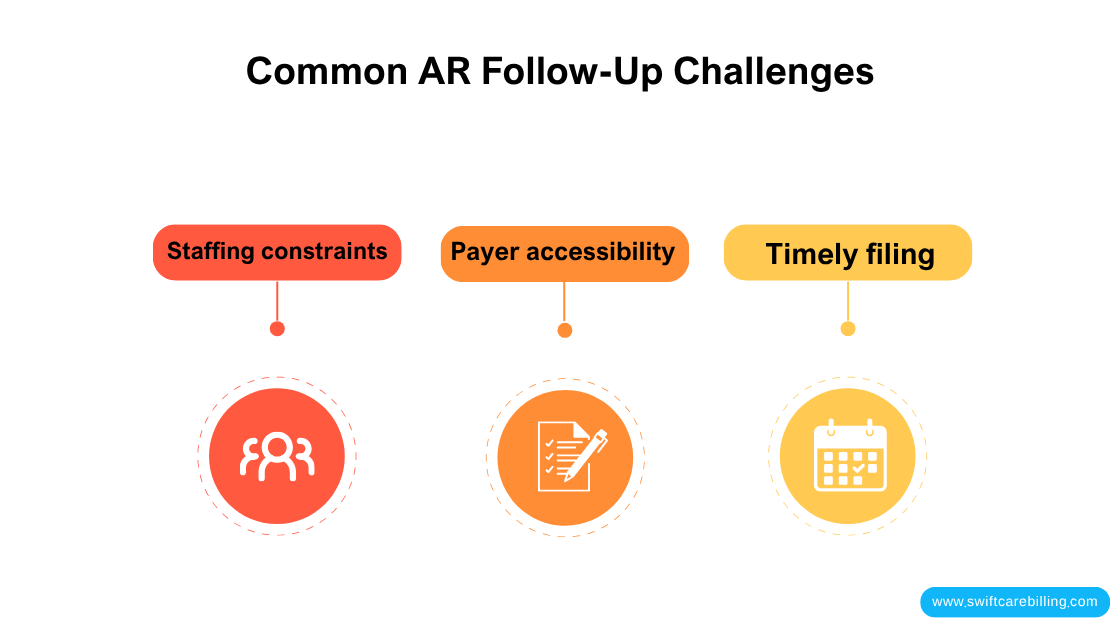
Staffing constraints often top the list. AR follow-up is labor-intensive, requiring dedicated personnel with specific knowledge of insurance procedures, coding, and payer policies. Many practices lack sufficient staff to conduct thorough follow-up, resulting in aging accounts receivable and lost revenue.
Payer accessibility presents another significant challenge. Long hold times on provider service lines, unresponsive representatives, and inconsistent information create frustration and inefficiency. Some payers lack transparent online portals, forcing billing staff to rely on time-consuming phone calls for basic claim status information.
Timely filing deadlines add pressure to the follow-up process. Most insurance contracts include clauses requiring claim submission or appeal within specific timeframes, often ninety to one hundred eighty days from the date of service or initial denial. Missing these deadlines results in permanent write-offs, making prompt follow-up essential.
Best Practices for Effective AR Follow-Up
Successful AR management requires implementing proven strategies and maintaining disciplined execution.
Prioritization based on claim value and age ensures that follow-up efforts yield maximum return. High-dollar claims and those approaching timely filing deadlines should receive immediate attention, while smaller balances in recent aging categories can be addressed through batch processing or automated tools.
Establishing payer-specific workflows improves efficiency. Different insurance companies have unique procedures, contact methods, and documentation requirements. Creating standardized protocols for each major payer reduces confusion and accelerates resolution.
Leveraging technology transforms AR follow-up from a manual slog into a manageable process. Modern practice management systems offer automated claim status checks, workflow queues, and predictive analytics that identify problematic claims before they age significantly. Electronic remittance advice reconciliation tools automatically post payments and flag variances requiring investigation.
Regular staff training maintains expertise and morale. The insurance landscape constantly evolves with policy changes, new billing requirements, and shifting reimbursement models. Ongoing education ensures staff remains current and confident in their follow-up activities.
Setting performance metrics and goals creates accountability and drives improvement. Key performance indicators might include days in accounts receivable, collection rates by aging bucket, first-pass resolution rates, and percentage of accounts receivable beyond ninety days. Regular monitoring and team discussions around these metrics foster a culture of continuous improvement.
The Financial Impact of Effective AR Follow-Up
The return on investment for robust AR follow-up processes is substantial. Practices that implement disciplined follow-up typically recover significantly more revenue from denied and delayed claims compared to those with passive approaches. Reduced days in accounts receivable accelerate cash flow, improving the ability to meet payroll, invest in equipment, and grow services.
Beyond immediate financial benefits, strong AR follow-up enhances overall revenue cycle health. The insights gained through follow-up activities reveal patterns in claim denials, payer payment behaviors, and coding issues—information that can drive process improvements preventing future problems.
Conclusion
Accounts receivable follow-up represents the bridge between providing healthcare services and receiving fair compensation for those services. While it demands resources, expertise, and persistence, effective AR follow-up is not optional for financially healthy medical practices. By implementing structured processes, leveraging technology, prioritizing strategically, and maintaining dedicated focus, healthcare organizations can optimize their collections, minimize write-offs, and ensure sustainable operations in an increasingly complex reimbursement environment.
Contact us for more details