



Bundling. Unbundling.
Two words that sound like you’re setting up a new internet plan — but in medical billing, they decide whether your claim gets paid fairly… or gets knocked out with a CO-97 faster than you can say “clean claim rate.”
If you deal with CPT codes like 99213, 90837, 71020, or if denial reason codes keep haunting your inbox, you’ve already brushed against these concepts. Maybe without realizing how much they influence revenue, coding accuracy, and audit risk.
This guide breaks down everything — what bundling and unbundling actually are, why payers care so much about them, how NCCI edits control the rules, and exactly how to avoid costly mistakes.
Whether you’re a coder, provider, or RCM lead trying to protect revenue, here’s the clarity you need to stay compliant and profitable.
What Is Bundling in Medical Billing?
Bundling is the process of grouping related medical services into a single CPT code instead of billing each step individually.
Think of it like a combo meal.
You don’t order the fries, drink, and burger separately. You buy the combo because it’s one event—one purchase—one code.
Healthcare works the same way:
If multiple services belong to a single clinically related encounter, payers expect you to bill the primary CPT code, which already includes everything.
Bundling streamlines coding and prevents overbilling.
It also keeps providers compliant with CMS rules and reduces the risk of payers accusing you of “charging for every little thing.”
Bundling:
- Keeps claims simple
- Aligns with payer policies
- Eliminates unnecessary separate charges
- Prevents duplicate billing
- Protects against fraudulent overcoding
- Reduces denials linked to incorrect combinations
If services are related and usually performed together, you don’t get paid for each piece—you bill the complete packaged code.
Bundling Saves You From:
- CO-97 denials
- Unnecessary documentation searches
- Incorrect claim rework
- Audit flags
- Lost reimbursements from improper combinations
Examples of Bundling With CPT Codes
Let’s look at real scenarios where bundling applies.
Example 1: Office Visit + Psychotherapy
A provider performs:
- 99213 (E/M office visit)
- 90837 (psychotherapy 60 minutes)
In many cases, NCCI edits show that psychotherapy already includes some elements of evaluation and management.
If the E/M isn’t separately identifiable and properly documented:
→ The E/M code bundles into psychotherapy.
→ Billing both without a modifier = denial.
Example 2: Chest X-Ray Views
A patient receives:
- 71010 (single-view)
- 71020 (two views)
CMS bundles the single-view into the two-view code.
Submitting both separately triggers CO-97 because 71020 already includes 71010.
Bundling rules are determined entirely by NCCI PTP edits, so always check Column 1 and Column 2 code pairs.
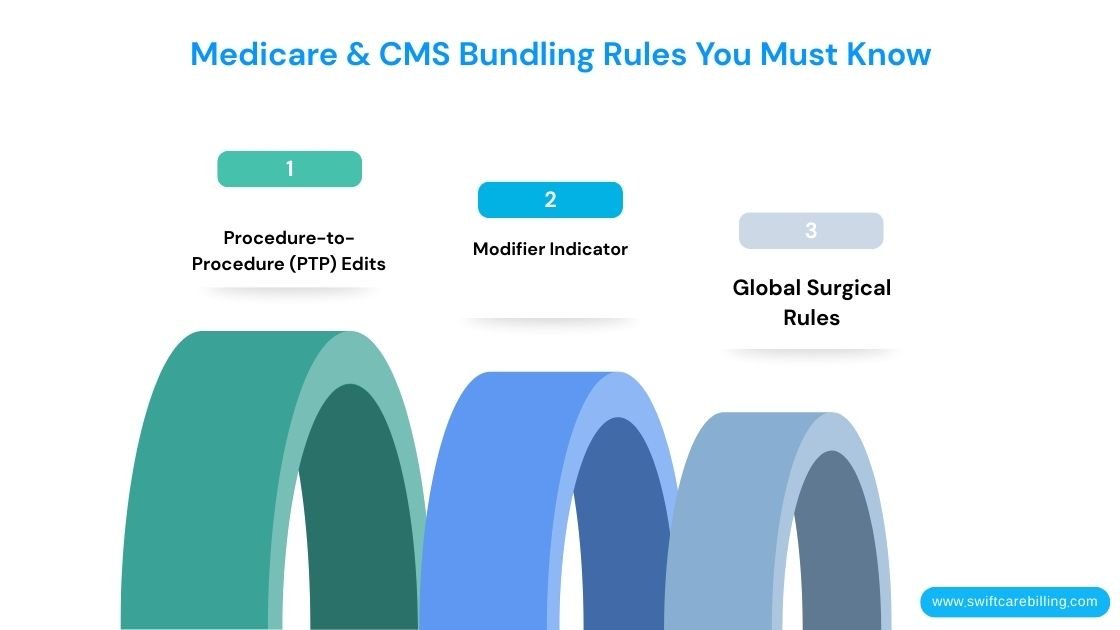
Medicare & CMS Bundling Rules You Must Know
Bundling isn’t optional — it’s mandatory under CMS policies.
Each quarter, CMS updates NCCI edits to define:
- Which codes must be billed together
- Which combinations are never allowed
- Which pairs can be separated with modifiers
- Which services fall under the global surgery package
Here are the three significant areas you MUST review:
1. Procedure-to-Procedure (PTP) Edits
These tell you whether two CPT codes conflict.
Column 1 = primary
Column 2 = bundled into Column 1
2. Modifier Indicator
- 0 → Modifier NOT allowed. Must bundle.
- 1 → Modifier allowed only if documentation proves separation.
3. Global Surgical Rules
Pre-op, intra-op, and post-op services are often bundled into a single CPT code for a surgical procedure.
Trying to bill them separately = instant denial.
Remember: Improper modifier use to bypass bundling is one of the fastest ways to land on an auditor’s radar.
Bundling Denial Code: CO-97
If you see CO-97 or PR-97, the payer is basically saying:
“This service is already included in another service you billed.”
CO-97 = bundled into another charge
PR-97 = same, but patient responsibility applies
Common Reasons for CO-97
- Coding two procedures that NCCI edits the bundle
- Missing a required modifier
- Documentation doesn’t justify separate billing
- Trying to bill step-by-step components of a single service
Each CO-97 denial wastes time, reduces reimbursement, and slows your A/R.
What Is Unbundling in Medical Billing?
Unbundling happens when a provider bills separate CPT codes for services that should be billed as a single comprehensive code.
This can happen accidentally… or intentionally.
Either way, payers view improper unbundling as a compliance threat because it leads to higher reimbursement than you’re entitled to.
Imagine buying a pre-assembled table.
Then the store charges you:
- One fee for the table
- Another for the legs
- Another for the screws
- Another for the manual
That’s unbundling — and payers won’t allow it.
Examples of Unbundling That Trigger Denials or Audits
Example 1: Minor Surgical Procedure
A simple wound repair includes:
- incision
- cleaning
- closure
- dressing
If the coder bills those individually instead of using 12001, that’s unbundling.
Example 2: Psychotherapy + E/M
A provider bills:
- 90837
- 99214
If the documentation doesn’t clearly show a separately identifiable E/M service, unbundling is assumed.
Without Modifier 25 + solid documentation → denial or audit.
Why Improper Unbundling Is Considered Fraud
Accidental unbundling is a mistake. Intentional unbundling is fraud.
CMS, OIG, and commercial payers treat this seriously because unbundling:
- Artificially increases payment
- Violates coding rules
- Misrepresents the clinical encounter
- Breaks HIPAA compliance
- Triggers repayment demands
- Leads to penalties or exclusion
Even minor repeated errors can put a practice on payer watchlists.
NCCI Edits and Modifiers: Your Safety Net
NCCI PTP edits are your map. Modifiers are your permission slip—if used correctly.
Key Modifiers for Legitimate Unbundling
- 59 – Distinct procedural service
- XE – Separate encounter
- XS – Separate structure
- XP – Separate practitioner
- XU – Unusual non-overlapping use
But here’s the catch:
Never use modifiers as a shortcut. They must reflect absolute clinical separation backed by documentation.
Payers track modifier patterns aggressively. Overuse = investigation.
Bundling vs Unbundling: The Difference
Bundling
- Bill one CPT code for related services
- Used for “normal,” expected combinations
- Reduces coder workload and payer confusion
- Supports compliance
- Minimizes denials
Unbundling
- Bills have multiple codes for services that payers expect to be combined
- Only allowed when services are truly distinct
- Requires strong documentation + correct modifiers
- High audit risk if misused
Here’s a comparison table:
| Aspect | Bundling | Unbundling |
| Purpose | Combine related services | Separate distinct services |
| Documentation | Simple | Must prove separation |
| Modifiers | Rare | Always needed (59, XE, XS, etc.) |
| Risk | Underbilling | Audits + denials |
| Driven by | NCCI edits | Clinical separation + payer rules |
| Common Denial | — | CO-97, PR-97 |
How Bundling and Unbundling Affect Revenue
Bundling and unbundling aren’t just abstract coding concepts — they have a direct, tangible impact on your practice’s bottom line. Every decision to bundle or unbundle services can either protect revenue or create losses. Let’s break it down.
Improper Over-Bundling → Lost Revenue.
Over-bundling occurs when services that should be billed separately are bundled into a single CPT code. This often happens when coders or providers try to simplify billing or misunderstand NCCI edits.
By bundling everything together, you may underbill. The payer only reimburses the bundled code, which may not capture all the services actually provided. Over time, repeated over-bundling can quietly erode revenue without raising any obvious red flags.
Example: A provider performs an established patient visit (99214) and orders additional lab tests that aren’t included in the evaluation. If these labs are mistakenly billed as part of the visit instead of separately, the practice loses the reimbursement for the labs — money that should have been captured.
2. Improper Unbundling → Denials + Repayments
Unbundling, the opposite scenario, occurs when services that should be billed together are billed separately. While it may temporarily increase reimbursement, it often triggers denials, recoupments, and audits.
The problem: Denial codes like CO-97 or PR-97 appear on your EOB, indicating that the payer considers the separately billed services as part of a bundled package. If the payer pays initially, post-payment audits can demand recoupments, creating financial headaches and administrative burden.
Example: A minor surgical procedure (e.g., wound debridement) includes cleaning, closure, and dressing. Billing each of these separately may lead to CO-97 denials. Even if some payment is received, it may later be reversed, creating unpredictable cash flow.
Clean, Correct Bundling → Better Revenue Cycle
When bundling and unbundling are applied correctly — meaning services are billed accurately according to NCCI edits, payer rules, and documentation — the benefits are immediate and measurable:
- Faster reimbursements: Claims pass payer edits more smoothly, reducing A/R days.
- Higher clean claim rate: Less rework means fewer denied or rejected claims.
- Less administrative rework: Staff spend less time correcting errors or appealing denials.
- Lower audit exposure: Accurate billing keeps your practice compliant with CMS, OIG, and commercial payer rules.
- Improved cash flow stability: Predictable payments make financial planning easier and reduce stress on the practice.
How to Avoid Bundling & Unbundling Errors
Top-performing RCM teams implement a few key practices to protect revenue:
- Check NCCI Edits Every Time: Procedure-to-procedure (PTP) edits and modifier indicators show which codes must be bundled and which may be billed separately. Following these rules prevents denials and underpayments.
- Use Modifiers Only When Justified: Don’t rely on Modifier 59, XE, XS, or XU as a workaround. Only use them when documentation clearly proves the services were separate.
- Train Providers on Documentation Requirements: Unbundling errors often start with poor notes. Providers should clearly document distinctions between services, timing, anatomical sites, and medical necessity.
- Review Global Surgery Rules: Many post-op visits or procedures are automatically bundled within the global period. Billing outside the rules can trigger denials.
- Track CO-97 Denials Monthly: Identify patterns early. Recurring CO-97 denials often point to coding errors or workflow issues that need correction.
- Audit E/M + Procedure Combinations: Certain combinations, like psychotherapy + E/M visits or minor procedures with additional services, are frequent unbundling hotspots. Routine audits can catch errors before claims are submitted.
- Update Billing Rules Quarterly: CMS updates NCCI edits four times a year. Staying current ensures compliance and reduces revenue leakage.
Conclusion
Bundling and unbundling aren’t just technicalities — they are critical levers for revenue integrity and compliance. Done correctly, they streamline billing, reduce denials, improve cash flow, and protect your practice from audits. Done incorrectly, they silently drain revenue and create legal and administrative risks.
The key is knowledge, documentation, and disciplined workflows: follow NCCI edits, use modifiers judiciously, train your staff, and maintain a robust auditing process. These steps turn a potential revenue leak into a predictable, clean, and efficient billing operation.
Maximize Revenue, Minimize Risk With Swiftcare Billing
At Swiftcare Billing, we help healthcare practices navigate the complex world of bundling and unbundling. Our team ensures your claims:
- Are coded accurately according to NCCI edits and payer rules
- Use modifiers correctly with supporting documentation
- Avoid CO-97 and PR-97 denials
- Maximize reimbursements while staying fully compliant
We take the guesswork out of revenue cycle management so you can focus on patient care rather than chasing down denied claims.