



Home health services involve medical care provided to patients’ home. However, many organizations discover that the complexities of invoicing, rather than therapeutic difficulties are impeding their expansion and viability. In order to preserve financial stability, guarantee regulatory compliance, and ultimately free up agencies to concentrate on what really matters, providing outstanding patient care, it is essential to master the billing process.
The Basics of Home Health Invoicing
The practice of submitting claims to payers for compensation of services rendered to patients in their homes is the fundamental component of home health billing. This may seem simple, but because of the different payers, rules, and code requirements involved, the reality is actually much more convoluted.
Important Figures in Home Health Invoicing
Patients: The home health service recipients whose coverage and eligibility affect the billing procedure.
Payers: Organizations in charge of paying home health agencies for the services they provide.
Medical Billing Companies: They submit claims and manage revenue cycle.
Clinicians: Healthcare professionals who give care and record services, such as nurses and practitioners.
The Procedure for Home Health Billing
A financially sound home health agency is built on a clear billing cycle roadmap, which is what separates providing treatment from getting compensated for it. Let’s discuss the crucial phases:
Verification of Eligibility and Patient Intake
When patient come to the doctor office, he/she needs to be verified for eligibility before providing treatment. This involves
- Gather precise patient data
- Check the perks and coverage of your insurance
- Ascertain whether the patient qualifies for home health services.
- Get any pre-authorizations that are required.
You save your agency from the headache of rejected claims and postponed payments when you confirm eligibility up front.
Delivery of Services and Documentation
Every billable service is built on the foundation of accurate, thorough documentation from your clinicians. This degree of documentation consists of:
- Comprehensive visit notes
- OASIS evaluations completed (for Medicare patients)
- Physician directives and treatment plans
- Any modifications to the patient’s condition or course of care
Both a clear clinical care plan and an audit-ready basis for your claims are produced by well-documented patient records.
Coding and Preparing Claims
The next stage is to convert services into billable codes after they have been documented. This includes:
- Using the proper ICD-10-CM diagnostic codes
- Choosing the appropriate procedure codes (CPT or HCPCS)
- Making sure all necessary claim fields are filled out correctly
The Patient-Driven Groupings Model (PDGM), which converts clinical criteria into reimbursement decisions, acts as your payment blueprint for Medicare claims.
Submission of a Claim
Now the claims are ready, it’s time to send them to the right payers. Usually, this procedure entails:
- Electronic submission via software or clearinghouses
- Verifying that claims adhere to format specifications (such as UB-04 for institutional claims)
- Respecting deadlines for timely filings
Advanced billing software reduces errors and streamlines processes, but selecting the appropriate software is important.
Posting and Reconciling Payments
Payments must be correctly deposited to patient accounts as soon as they are received. This comprises:
- matching payments to claims that have been filed
- Finding and fixing any inconsistencies
- Making changes to contracts
Beyond just balancing your books, smart payment posting identifies reimbursement trends that can influence future billing tactics.
Denial Management and Follow-Up
Even well-prepared claims occasionally encounter obstacles. Maintaining a strong response strategy keeps money coming in:
- Regularly monitoring the status of claims
- Resolving denials as soon as possible
- Using supporting documentation to appeal incorrect denials
- Resubmitting amended claims as needed
Your agency’s financial performance is strengthened by a well-designed rejection management system that converts possible lost revenue into captured payments.
Challenges with Home Health Billing
Every step of the home health billing process involves new challenges. Recognizing them is important to conquer.
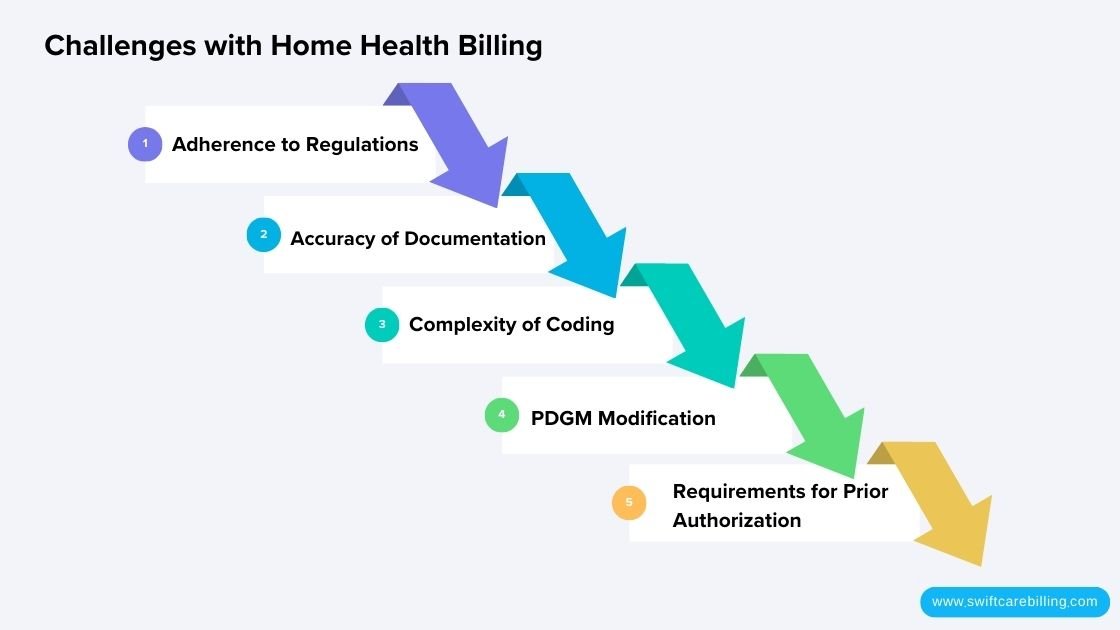
Adherence to Regulations
Keep updated with the regulations and updated rules of Medicare and Medicaid and different insurance policies
Accuracy of Documentation
Assisting your clinical team in understanding how their documentation directly affects reimbursement is the first step towards success. Documentation needs to be completed and accurate.
Complexity of Coding
In-depth knowledge of ICD-10-CM, CPT, and HCPCS codes is necessary for proper coding, as is comprehension of home health-specific coding requirements.
PDGM Modification
Revenue cycle management and billing procedures have had to change significantly as a result of the switch to the Patient-Driven Groupings Model.
Requirements for Prior Authorization
If prior authorization requirements are mismanaged, they can restrict your cash flow to a trickle and provide a bottleneck between patient acceptance and service delivery.
On-time Filing Deadlines
Revenue loss may arise from missing filing deadlines. Every payer has specific timely filing criteria that need to be closely monitored and fulfilled.
The Best Methods for Efficient Home Health Invoicing
Consider putting these best practices into practice to get beyond these obstacles and streamline your billing procedures:
Training
Provide training to your staff regarding regulatory changes, coding modifications, and documentation requirements.
Put Sturdy Technology Solutions in Place
Make use of the updated software to
- Simplify the documentation
- Automate the submission of claims
- Verify eligibility in real time.
- Provide metrics to track performance.
- Build Robust Payer Connections
Efficiency can be made or broken by your payer contacts. Invest in these connections to establish clear routes for problem solving and obtain early insight on policy updates.
Create a Program for Quality Assurance
To find opportunities for improvement and guarantee adherence to rules and payer requirements, audit claims and documentation on a regular basis. Put Denial Prevention First, Examine denial trends and take proactive steps to resolve prevalent problems prior to filing claims.
Make Your Revenue Cycle Management Better
You can make your revenue cycle management better with
- Resources for dedicated billing
- Advanced reporting and analytics
- Proficiency with regulatory compliance
- Continuous billing process optimization
Interoperability
Billing procedures will be streamlined and errors will be decreased with better data exchange between providers, payers, and patients.
Financial Responsibility of Patients
Managing patient payments is a more crucial part of home health billing as high-deductible health plans proliferate. Make sure to manage it efficiently.
SwiftCare Billing excels in home health billing because it requires accuracy, knowledge, and commitment. To improve the financial performance of your agency, we offer complete solutions shaped by decades of industry experience. We assist you on your path to optimal financial performance, whether you require state-of-the-art technology deployment or ongoing training and assistance.