



Cardiology practices profit handsomely from echocardiography. When paperwork is inadequate, it also results in claim denials. A significant portion of these claims are related to CPT code 93306. If you make a mistake, you’ll either be fighting denials or losing money.
Four imaging components are needed for the transthoracic echocardiography CPT code: spectral Doppler, colour flow Doppler, M-mode recording, and two-dimensional real-time imaging. Three out of four do not work with procedure code 93306. All four must be completed and recorded, or else the incorrect code is being billed.
This article explains what payers look for in documentation, when the CPT code for echo studies under 93306 truly applies, and the errors that result in claims being refused or downcoded.
CPT Code 93306: What is it?
Complete transthoracic echocardiogram without contrast is billed under CPT code 93306. A complete cardiac ultrasound through the chest wall is covered by this echocardiography procedure code.
Technical and professional components are both included in global billing. It is among the most often reported codes for cardiac imaging in cardiology billing services.
Description of CPT Code 93306
Four imaging components are needed to describe the 93306 CPT code:
1) Real-time imaging in two dimensions (2D)
2) M-mode capture
3) Echocardiography using spectral Doppler
4) Doppler colour flow
Complete evaluation of the heart using ultrasound transducers on the chest wall. Every single one of the four components needs to be completed and recorded.
CPT Code 93306’s Clinical Uses
When a thorough diagnostic heart assessment is required, the transthoracic echocardiography CPT code is applicable. Denials can be avoided by understanding when 93306 fits in comparison to other echo codes.
In situations where procedure code 93306 is usually applicable:
First Cardiac Evaluation
A new cardiac murmur is discovered during a routine appointment with a 62-year-old patient. No prior echoes or cardiac history. In order to measure chambers, examine wall motion, evaluate valve structure, and measure blood flow, the cardiologist schedules a full echo.
This is where CPT code 93306 fits. All chambers, all valves, and a thorough Doppler investigation are required for the new discovery. Instead of focusing only on the location of the murmur, you are establishing baseline over the entire heart.
Assessment of Chest Pain
The patient has been experiencing sporadic chest pain for the past two weeks. Nonspecific alterations are seen in the EKG. CAD, heart failure, valve issues, and irregular wall motion must all be ruled out by a doctor.
Because you are assessing several causes rather than focusing on a single structure, procedure code 93306 is effective. Examining function, valves, chamber diameters, Doppler investigations, and a thorough, non-focused assessment are all parts of the chest pain workup.
Cardiac Clearance Prior to Surgery
In three weeks, the 68-year-old patient with hypertension will have a significant surgical procedure. The surgeon requests cardiac clearance. For baseline function, valve evaluation, ejection fraction, and structural assessment, the cardiologist orders a full echo.
CPT code 93306 is relevant. A thorough baseline, ejection fraction, valve function, RV function, and pulmonary pressures are required for pre-operative clearance. All of this is necessary for risk assessment in anesthesia.
Echocardiography under stress
Stress echo CPT codes 93350 or 93351 are used for exercise or pharmacologic stress testing with echo imaging. Baseline and stress pictures are among such codes.
Unless there are clear medical justifications, invoicing 93306 plus stress echo is duplicate billing.
CPT Code 93306: When Not to Use It
A patient who has a known mitral valve prolapse comes back for a focused assessment of the mitral valve’s function alone. This is a targeted assessment rather than a full, comprehensive research.
This indicates that the restricted echo CPT code is 93308, not 93306. For billing purposes, the distinction is important.
CPT Code 93306 Documentation Requirements
Documentation that satisfies payer requirements is required to be reimbursed for CPT code 93306 through cardiology billing services.
Establishment of Medical Needs
A clear clinical indication is required for the report. There must be a reason to order the test, such as dyspnea, heart murmur, chest pain, or pre-operative examination. The patient’s reason for being there should be closely related to the indication.
Verification of Components
This is where a lot of assertions falter. It must be stated clearly in the documentation that each of the four components was completed:
i) 2D imaging in real time
ii) M-mode recording was acquired
iii) Completed spectral Doppler echocardiography
iv) Colour flow Doppler was used.
Both spectral and colour flow Doppler should be mentioned explicitly in the documentation. This distinguishes CPT codes 93306 and 93307. When this is omitted, automatic downcoding frequently occurs.
Details of the Structural Assessment
Payers want proof that you looked at everything. Statements that are generic are insufficient. The documentation requires a certain evaluation of:
Atria and Ventricles:
Size, wall thickness, systolic function, and ejection fraction of the left ventricle
The size and function of the right ventricle
Both atria: sizes recorded
Valves
Structure and function of the mitral, tricuspid, aortic, and pulmonic
Any recorded stenosis or regurgitation
Additional Structures:
Pericardium: effusion presence or absence
Measurements of adjacent aortic segments
Measurement and Haemodynamic Data
Haemodynamic evaluation and intracardiac blood flow patterns from the Doppler examinations should be included in the report; precise statistics are important: Doppler velocities, valve areas, chamber dimensions, wall thickness, and quantitative measurements with recorded values. Make a note of whether each measurement is within the typical range.
Give a clinical explanation of what is abnormal. “Left ventricular ejection fraction 35%, indicating moderately reduced systolic function” is a better way to describe this.
Physician Signature and Interpretation
The entire report is signed and dated by the interpreting physician. If an electronic signature satisfies authentication standards, it can be used.
Instead of merely providing a list of measurements, the interpretation synthesises findings into something clinically meaningful.
Linkage of Diagnosis Codes
Link the relevant ICD-10 diagnostic codes that demonstrate medical necessity. Typical supportive diagnoses consist of:
Pain in the chest (R07.9)
murmur of the heart (R01.1)
Dyspnoea (R06.00)
High blood pressure (I10)
I25.10 Coronary artery disease
Heart failure (I50.9)
The diagnosis must correspond with the study’s motivation as stated in the documentation.
Typical Documentation Mistakes
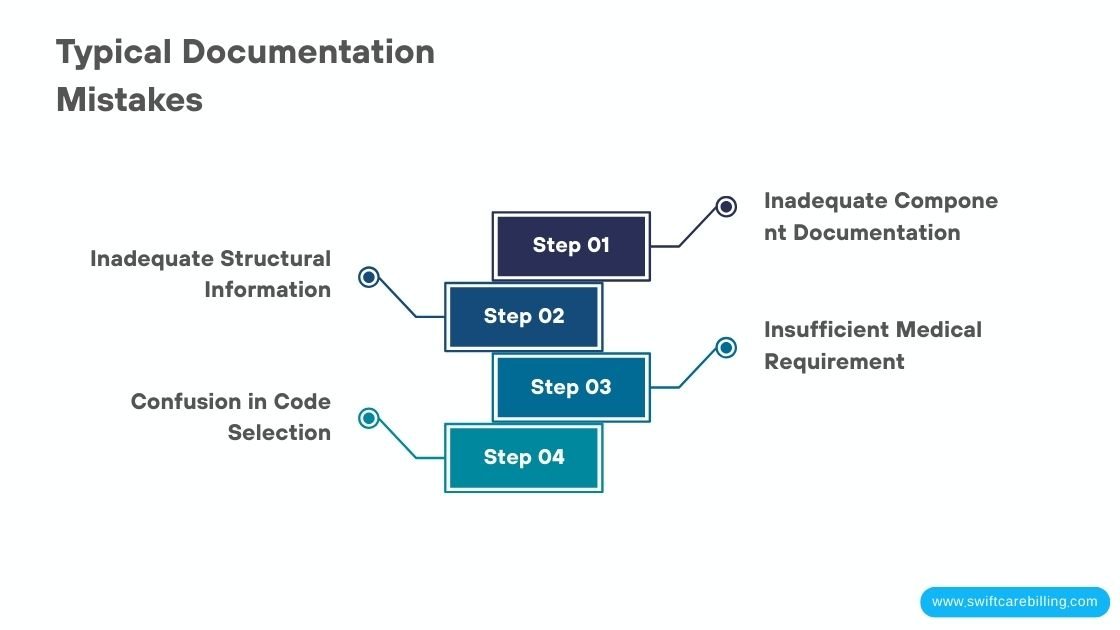
Billing CPT code 93306 appears simple until claims begin to be rejected. A number of recurring patterns appear, such as:
Inadequate Component Documentation
The most common issue is not fully stating all four necessary components. The report may include some Doppler data and summarise results from 2D imaging.
However, payers refuse or downcode if it doesn’t explicitly say that M-mode, spectral Doppler, and colour flow Doppler were all carried out. Clearly state each element.
Inadequate Structural Information
Documentation criteria are not met by “All chambers appear normal.” Patients anticipate precise results with accurate measurements for every chamber and valve.
Templates help here; they prompt documentation of all required elements and prevent omissions.
Missing Doppler Confirmation There is a danger of downcoding to 93307 for reports that do not specifically confirm spectral and colour flow Doppler performance. That could result in a reimbursement reduction of 20–30% simply for neglecting to record an actual action.
Include clear language: “Colour flow Doppler and spectral Doppler were used in the study.”
Insufficient Medical Requirement
Payers reject claims when supporting documentation does not explain why the study was ordered. Note any clinical findings, presenting symptoms, or medical history that made the evaluation necessary.
Make it clear why this test was required and link it to the proper diagnosis codes.
Confusion in Code Selection
Denials occur when CPT code 93306 is used for targeted follow-up research. CPT code 93308 applies if the clinical inquiry focusses on particular structures rather than necessitating a thorough assessment.
The extent of what was really done and the rationale behind that strategy should be reflected in the documentation.
Global Billing:
When a single provider or group handles both technical work and expert interpretation, global billing (no modifier) is applicable. In 2025, this results in full compensation, or about $235 under Medicare.
The professional component (26) usually accounts for around 40% of the global charge when components are billed separately. Although this varies by location, the technical component (TC) accounts for roughly 60% of the total.
Payer Considerations These payer criteria must also be taken into account when billing CPT code 93306.
Medicare Protection
When medical necessity is appropriately documented, Medicare will pay for CPT code 93306. 120–200% of Medicare prices are typically reimbursed by private insurance.
Payers differ greatly in their prior authorisation processes and documentation requirements.
Prior Permission
For echocardiograms, many commercial payers demand prior authorisation. Even with flawless documentation, payment may be refused if authorisation is not obtained prior to conducting the study.
Before scheduling studies, confirm requirements with each payer.
Regional Differences
Regional variation results from the rates set by Medicare Administrative Contractors for their respective jurisdictions. The reported Medicare worldwide billing rate of about $235 is an average for the entire country. Where services are rendered determines the actual rates.
Scrutiny of Compliance
Excessive echocardiography billing was particularly identified as a compliance issue in the 2024 OIG report. Practices that bill under CPT code 93306 are often subject to increased scrutiny for medical necessity and frequency.
A thorough clinical explanation outlining how the patient’s condition has changed since the previous study is required for every follow-up investigation. Audits are encouraged when standard follow-up echoes are ordered without documented clinical changes.
Conclusion:
Revenue for practitioners billing CPT code 93306 is directly impacted by the quality of their documentation. The stakes have gone beyond straightforward claim denials because to heightened compliance scrutiny in the wake of the 2024 OIG report. Practices must have documentation criteria that support the proper use of the transthoracic echocardiography CPT code while withstanding audit scrutiny.
Procedure code 93306 and restricted echo CPT code 93308 differ not just clinically but also financially. Attention to component documentation and medical need is necessary to constantly get it correctly. Establishing clear procedures now avoids compliance problems later, whether billing is managed internally or in collaboration with cardiac billing services.