



Podiatric medical billing is a bit complex and requires accuracy. A lot of data need to be submitted correctly to prevent loss of revenue, denied claims or delayed payments. Understanding and correcting typical errors in podiatrist medical billing maximize revenue and improve patient satisfaction.
Managing and organizing the administrative and financial parts of podiatry is important. Prompt reimbursement requires appropriate claim filing, accurate coding and fulfillment of industry rules. Podiatry claim denial reasons include inaccurate data entry, errors in claim filing, and inaccurate coding that leads to payment delays and decreasing income. These errors need to be fixed to receive payments and run billing procedures smoothly.
Below are some main podiatry claim denial reasons:
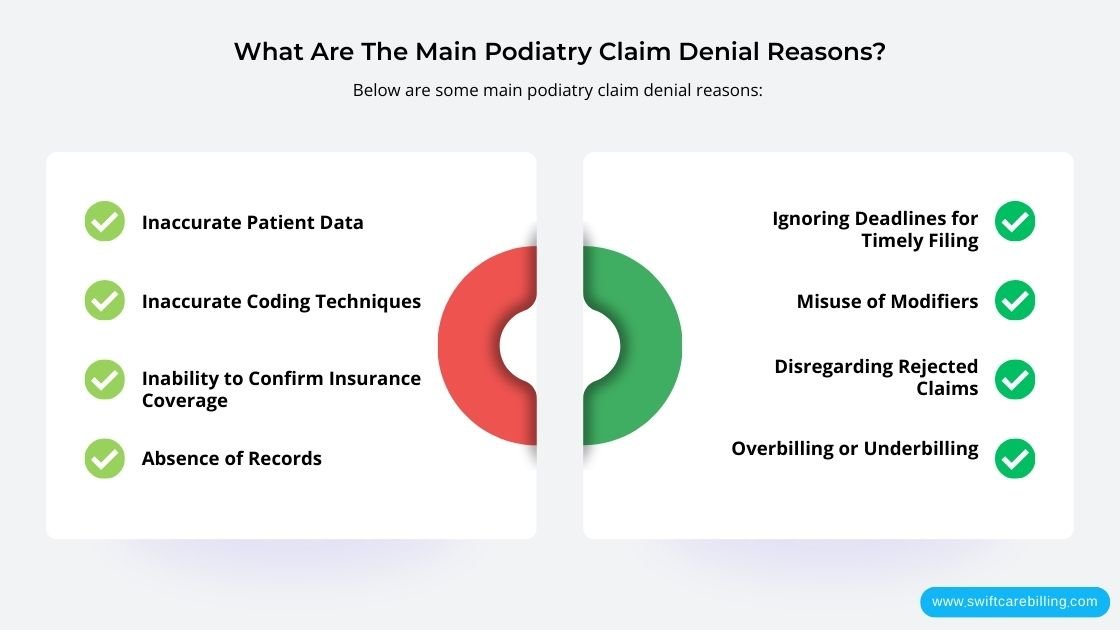
Inaccurate Patient Data
Patients’ data need to be completed and entered correctly to prevent denials as it is one of the main podiatry claim denial reasons. Even a single mistake in patient data such as patient’s name, birthdate, insurance policy number and phone number can become the cause of claim denials or take time to process. Repeated errors also affect practice’s credibility with payers, making them more skeptical of subsequent claims.
Inaccurate Coding Techniques
Coding is one of the main parts of medical billing that needs to be corrected.
Even a minor error in the codes can have a significant impact on the reimbursement or denial of treatments or diagnosis. Claims may be rejected due to obsolete codes, inconsistencies with Current Procedural Terminology codes, insufficient international classification of diseases (ICD-10) codes, or inaccurate HCPCS codes. Additionally, coding mistakes may trigger audits that result in payment delays and penalties for the practice.
Inability to Confirm Insurance Coverage
Another main error that can result in an enormous financial loss is filing a claim without verifying a patient’s insurance status. Insurance companies usually remove treatments that were previously covered from the patient’s benefit plan, and insurance plans are subject to periodic changes. If the patient’s insurance plan is not correctly reviewed, the practice may be forced to pay or transfer the procedural costs to the patient, or the claim may be denied.
Absence of Records
Incomplete or inadequate documentation sometimes results in claim rejection in podiatrist medical billing. Practitioners must give insurance payers all required paperwork and medical records in order to prevent this. It demonstrates the medical need of the services provided. A poorly documented diagnosis, an insufficient progress note, or the lack of operative records might result in audits, payment delays, or outright claim denial.
Ignoring Deadlines for Timely Filing
There is a loss of income since insurance firms have extremely tight deadlines for filing claims. Furthermore, late filings are typically rejected outright, which means that reimbursements are lost. In addition, the interaction between late-filed claims and payers makes future transactions more difficult.
Misuse of Modifiers
The context of the treatment or service is indicated by modifiers in podiatry billing. It guarantees if the physician carried out the procedure in numerous procedures or bilaterally. Use of incorrect modifies may confuse the payer which can lead to claim denial, reduction in payment and a request for more information.
Disregarding Rejected Claims
A costly error that could cause the practice’s revenue to soar is failing to promptly react to denied claims. These ignored rejections eventually lead to significant financial strain and exacerbate the AR backlogs.
Overbilling or Underbilling
The two most frequent issues with medical billing are overbilling and underbilling. Errors in CPT codes or ignorance of podiatry billing procedures can lead to underbilling, which reduces income. However, because of the official audits that began with overbilling itself, overbilling invites legal sanctions.
Observance of Regulations
Every practice including podiatry requires completion of HIPAA compliance and fulfillment of regulatory guidelines. Therefore, it is important to fulfill payer-specific policies, CMS guidelines, legal issues. Noncompliance issues lead to financial penalties, legal issues and a bad reputation. Fulfillment of these rules and regulation and employees training can prevent these compliance problems.
Using the Updated Technology
Advanced tools and software have replaced a lot of manual work. Procedures have been upgraded and now updated technology usage has made the life much easier. It has reduced human error, inefficiencies and reimbursement delays. Now, technology have introduced billing systems software that track claims, manage patients’ data and code to speed up the process of payment recovery.
Conclusion
Medical billing in podiatry is a vital and difficult field that needs meticulous attention to detail, current knowledge, and strategies to prevent podiatry claim denial reasons. Incorrect data, late claim submission, and inaccurate coding lead to less revenue and negative impact on practice’s finances.
Therefore, few things need to be considering preventing these errors. It is important to train your staff, use suitable and updated software, submit accurate claims, verify insurance benefits, and follow regulatory compliance. These measures will ensure accuracy in data, faster reimbursements and improvement in revenue cycle. Reducing billing errors helps your practice’s profitability and frees you up to concentrate on patient care.