



Revenue cycle management (RCM) in healthcare is more than just billing. It is the backbone of a healthcare provider’s financial stability, impacting everything from cash flow to patient satisfaction. For providers navigating the complex healthcare reimbursement landscape, understanding the healthcare revenue cycle and optimizing it effectively can make the difference between steady growth and financial strain.
In this guide, we’ll break down what RCM is, its key stages, challenges, best practices, and the technology shaping its future—helping providers stay ahead in the ever-evolving healthcare environment.
Introduction to Revenue Cycle Management (RCM)
Revenue cycle management in healthcare refers to the process that tracks a patient’s journey from their initial appointment to the final payment of services rendered. Essentially, it’s the financial workflow that ensures providers are reimbursed accurately and on time for the care they deliver.
RCM is critical for providers’ financial health. Delays or errors in the revenue cycle can lead to reduced cash flow, increased accounts receivable (AR) days, and even claim denials that hurt profitability. But beyond finances, RCM directly impacts patient experience and care delivery. A smooth revenue cycle ensures patients face fewer billing issues, receive clear statements, and have access to flexible payment options—creating a positive interaction with the practice.
What Is Revenue Cycle Management in Healthcare?
Revenue cycle management in healthcare is a structured process that transforms clinical services into revenue. It encompasses all the administrative and clinical functions that contribute to the capture, management, and collection of patient service revenue.
The healthcare revenue cycle begins when a patient schedules an appointment and continues through registration, coding, claim submission, payment posting, and final collection. Multiple stakeholders are involved: providers who deliver care, payers who process and reimburse claims, and patients who ultimately incur out-of-pocket costs.
Understanding RCM in healthcare helps providers see the whole lifecycle and identify opportunities for operational efficiency, financial optimization, and patient satisfaction.
Key Stages of the Healthcare Revenue Cycle
The healthcare revenue cycle consists of several interconnected stages. Each step, if handled correctly, ensures timely reimbursement and minimizes revenue leakage.
Patient Scheduling and Registration
Accurate patient demographics are the foundation of a clean revenue cycle. Capturing the correct name, address, insurance details, and contact information prevents future claim rejections. Pre-authorizations and insurance verifications during registration can also prevent delays and denials downstream.
Insurance Verification and Eligibility
Real-time eligibility checks confirm that the patient’s insurance covers the intended services. This step is crucial to prevent front-end denials, which can lead to delayed payments and frustrated patients. Automated verification tools have become essential in modern RCM healthcare workflows.
Medical Coding and Charge Capture
Proper coding is central to healthcare reimbursement. ICD-10, CPT, and HCPCS codes must reflect the clinical services provided. Accurate documentation supports claims, ensures compliance, and minimizes denials. Coding errors are a leading cause of revenue loss for providers.
Claims Submission
Submitting claims electronically improves speed and accuracy. Clean claims that adhere to payer requirements ensure timely filing and reduce the risk of denials. Providers must monitor claim status and promptly address any rejections or errors.
Payment Posting and Reconciliation
Electronic Remittance Advice (ERA) and Explanation of Benefits (EOB) processing allow providers to reconcile payments efficiently. Identifying underpayments and posting payments accurately ensures the practice maintains a healthy cash flow.
Denial Management and Appeals
Denials are inevitable but manageable. Common reasons include coding errors, missing documentation, or payer-specific rules. Implementing a structured denial management process—including timely appeals—can recover lost revenue and prevent repeated errors.
Patient Billing and Collections
Transparent billing and patient-friendly payment options enhance patient satisfaction and reduce collection challenges. Providing clear statements and flexible plans ensures patients are engaged and less likely to delay payments.
Importance of Revenue Cycle Management for Healthcare Providers
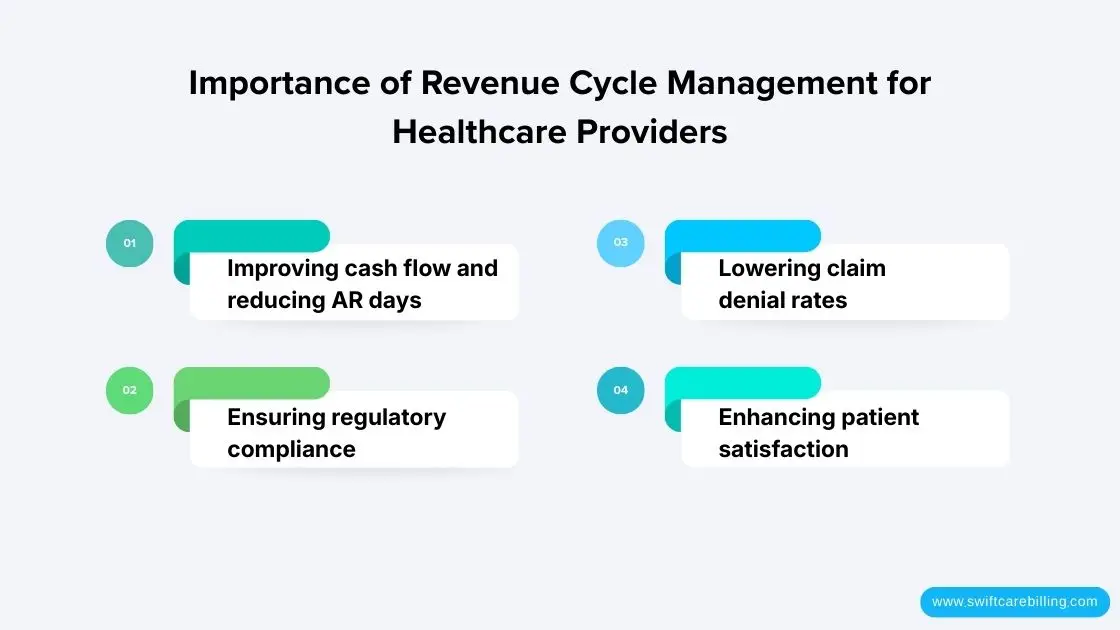
Effective RCM directly benefits providers by:
- Improving cash flow and reducing AR days: Faster claim processing means more predictable revenue.
- Lowering claim denial rates: Accuracy in coding, eligibility checks, and claim submission reduces rejections.
- Ensuring regulatory compliance: Proper documentation keeps providers aligned with CMS and HIPAA regulations.
- Enhancing patient satisfaction: A smooth billing process prevents frustration and builds trust.
Healthcare reimbursement depends on more than just delivering services—it relies on managing the revenue cycle efficiently. Providers who prioritize RCM see measurable improvements in both financial stability and patient retention.
Common Revenue Cycle Management Challenges
Revenue cycle management in healthcare is complex, and providers often face significant hurdles that can disrupt cash flow, increase administrative workload, and impact patient satisfaction. Understanding these RCM challenges is essential to safeguard revenue and maintain operational efficiency.
Coding and Documentation Errors
Errors in medical coding and documentation are among the leading RCM challenges. When ICD-10, CPT, or HCPCS codes are incorrect or incomplete, claims are frequently denied or delayed. Improper documentation not only affects reimbursement but also increases the risk of payer and CMS audits. For example, missing clinical details or failing to link diagnoses to procedures can lead to claim rejections, resulting in lost or delayed revenue for providers.
Claim Denials and Delayed Payments
Claim denials are a common pain point in the healthcare revenue cycle. Denials can occur due to eligibility mismatches, prior authorization lapses, or incomplete coding. Each denial requires follow-up and, in some cases, appeals, creating an administrative burden. Delayed payments affect cash flow and can increase accounts receivable (AR) days, forcing practices to allocate resources to reprocess claims rather than focus on patient care.
Staffing Shortages and Training Gaps
Many practices face challenges due to insufficient billing staff or gaps in training. Inexperienced teams may struggle to keep up with the increasing complexity of medical billing processes, payer rules, and compliance requirements. Without proper training, even small errors in documentation, coding, or claim submission can result in denied claims, reduced reimbursement, and operational inefficiency.
Complex Payer Regulations
Healthcare providers must navigate a labyrinth of payer-specific rules. Commercial insurers, Medicare, and Medicaid each have unique claim submission requirements, authorization protocols, and documentation standards. Staying up to date with these changing regulations is challenging but necessary to prevent errors, denials, and compliance issues.
Addressing RCM Challenges
Proactively addressing these RCM challenges involves continuous staff education, implementing verification processes, leveraging automation, and maintaining clear workflows for coding, claims, and denial management. Recognizing these pain points allows providers to reduce revenue leakage, streamline operations, and improve overall financial performance.
Best Practices for Effective RCM in Healthcare
Optimizing the revenue cycle requires a strategic, proactive approach. Implementing best practices ensures that claims are submitted accurately, reimbursements are timely, and patient satisfaction remains high.
Front-End Process Optimization
The foundation of effective RCM is front-end accuracy. Ensuring correct patient registration, capturing demographics, verifying insurance eligibility, and obtaining pre-authorizations reduces errors downstream. A clean front-end process minimizes claim rejections and accelerates payment cycles, allowing providers to focus on care delivery rather than administrative troubleshooting.
Regular Coding Audits and Staff Training
Continuous education and auditing are essential to prevent errors. Conducting regular coding audits ensures claims reflect the services rendered and comply with payer requirements. Staff training on documentation standards, payer updates, and coding guidelines not only reduces claim denials but also enhances efficiency.
Use of Automation and AI Tools
Automation is revolutionizing healthcare billing optimization. By automating repetitive tasks such as eligibility checks, code validation, and claims tracking, providers can reduce human error and improve turnaround time. AI tools can also predict claim denials, flag high-risk claims, and optimize coding accuracy, thereby significantly streamlining the healthcare revenue cycle.
Strong Payer Follow-Up Workflows
Even with accurate claims, follow-up is essential. Establishing structured payer communication workflows ensures the timely resolution of denied claims, underpayments, or delayed reimbursements. A proactive follow-up strategy reduces revenue leakage and strengthens provider-payer relationships.
Implementing these RCM best practices creates a resilient revenue cycle, improves cash flow, and allows providers to focus on patient care rather than constant revenue troubleshooting.
Technology and Automation in Revenue Cycle Management
Modern RCM healthcare relies heavily on advanced technology and automation. Leveraging the right tools not only streamlines operations but also reduces errors, improves compliance, and enhances patient satisfaction.
RCM Software and EHR Integration
Integrated RCM software ensures that clinical and financial data flow seamlessly from the EHR to billing systems. This reduces manual entry errors, accelerates claim submissions, and ensures accurate charge capture. With real-time updates and reporting, providers can efficiently track the status of claims, payments, and AR.
AI and Predictive Analytics
Artificial intelligence and predictive analytics are transforming healthcare billing. These tools identify patterns that may cause claim denials, predict delays, and recommend corrective actions. By analyzing historical data, AI helps practices anticipate challenges and optimize workflows before issues impact revenue.
Automation for Eligibility, Coding, and Denials
Automation is key for routine, repetitive tasks. Real-time eligibility verification, automated coding checks, and denial alerts allow billing teams to focus on higher-value tasks such as appeals and patient communication. This reduces operational bottlenecks, accelerates reimbursements, and lowers AR days.
Investing in RCM software and automation tools improves efficiency, enhances compliance, and supports a patient-friendly revenue cycle experience.
In-House vs Outsourced Revenue Cycle Management
Providers have two main options for managing RCM: in-house or outsourced. Each approach has advantages and trade-offs.
In-House RCM
Managing RCM internally gives providers complete control over billing operations. Practices can directly oversee staff, coding, and workflows, ensuring alignment with organizational priorities. However, in-house RCM requires significant investment in trained staff, software, and ongoing education. Staffing shortages or errors can directly impact revenue.
Outsourced RCM Services
Outsourcing RCM services offers expertise, scalability, and reduced administrative burden. Providers gain access to trained professionals, advanced technology, and efficient workflows without the need for large internal teams. Outsourcing is particularly beneficial for small to mid-sized practices aiming to reduce AR days, minimize claim denials, and optimize revenue without overextending staff.
Choosing the Right Partner
When selecting an outsourced partner, providers should evaluate experience, technology capabilities, compliance standards, and integration with existing EHR systems. A strategic partner ensures seamless operations, improved reimbursement, and better patient billing experiences.
Revenue Cycle Management and Compliance
Compliance is a non-negotiable aspect of RCM healthcare. Failure to adhere to regulations can lead to penalties, audits, and lost revenue.
HIPAA and Data Security
Protecting patient data is essential throughout the revenue cycle. HIPAA-compliant processes prevent unauthorized access, data breaches, and associated liabilities. Security measures should be in place for electronic records, claims submission, and patient communications.
CMS and Payer Regulations
Providers must comply with CMS, Medicaid, Medicare, and commercial payer rules. Accurate coding, timely submissions, and proper documentation are critical for compliance and smooth reimbursement.
Accurate Documentation and Audits
Proper documentation ensures claims are defensible during audits. Regular internal audits verify coding accuracy, completeness, and compliance, reducing the risk of penalties and improving revenue integrity.
A compliant RCM process safeguards finances while maintaining trust and operational integrity.
Future Trends in Healthcare Revenue Cycle Management
The healthcare revenue cycle is evolving rapidly. Providers must adapt to new trends to remain financially sustainable.
Shift Toward Value-Based Care
Reimbursement models increasingly focus on outcomes rather than volume. Providers must track performance metrics, quality measures, and patient satisfaction to ensure proper reimbursement under value-based care agreements.
Increased Automation and AI Adoption
AI and automation are no longer optional—they are integral to efficient RCM. Predictive analytics, automated coding, and real-time denial management are becoming standard, enabling proactive revenue cycle optimization.
Patient-Centric Billing Models
Transparency in billing and flexible payment options improve patient satisfaction. Modern RCM emphasizes patient communication and ease of payment, aligning financial processes with the patient experience.
Real-Time and Predictive RCM
The next generation of RCM allows providers to anticipate issues before they occur. Predictive analytics, dashboards, and automated alerts enable real-time monitoring and decision-making, minimizing revenue leakage and optimizing cash flow.
Conclusion
Revenue cycle management in healthcare is essential for maintaining financial stability and operational efficiency. By understanding healthcare revenue cycle steps, addressing RCM challenges, adopting best practices, leveraging technology, and ensuring compliance, providers can reduce claim denials, improve cash flow, and enhance patient satisfaction.
RCM is not just about faster payments—it’s about creating a resilient, compliant, and patient-focused practice. Providers who prioritize revenue cycle optimization position themselves for long-term growth and improved financial health.
FAQs
What is the goal of revenue cycle management?
The goal of revenue cycle management is to streamline the patient-to-payment process, ensuring claims are submitted accurately and reimbursed on time. Effective RCM reduces administrative inefficiencies, prevents revenue leakage, and supports the financial stability of healthcare providers. Optimizing these processes also enhances patient satisfaction by minimizing billing errors.
How long is the healthcare revenue cycle?
The healthcare revenue cycle typically begins with patient registration and continues until the final payment is posted. The duration varies depending on payer requirements, claim complexity, and internal workflows. Efficient revenue cycle management can shorten this timeline, improve cash flow, and reduce accounts receivable days.
What are key RCM KPIs providers should track?
Providers should monitor metrics such as accounts receivable (AR) days, claim denial rates, clean claim percentages, and patient collection efficiency. Tracking these revenue cycle metrics helps identify bottlenecks, evaluate process effectiveness, and optimize overall financial performance. Regular review of KPIs enables proactive management of potential revenue issues.