



Navigating healthcare can feel like walking through a maze of specialists, bills, and insurance paperwork. At the center of this maze is your Primary Care Physician (PCP) — the medical professional who acts as the hub for your health, guiding your care, coordinating with specialists, and keeping your health records organized.
For healthcare providers, PCPs are not just essential for patient outcomes; they’re also critical to revenue cycle management (RCM). Understanding how PCP visits are billed, how insurance allowed amounts work, and how claims flow through the RCM process can prevent lost revenue, reduce denials, and improve patient satisfaction.
Let’s break it all down.
What Is a Primary Care Physician (PCP)?
A Primary Care Physician is a doctor who provides comprehensive, first-contact care. Unlike specialists, PCPs treat a broad range of conditions, manage chronic diseases, and focus on preventive care. They also serve as the patient’s point of contact within the healthcare system.
Core responsibilities of a PCP include:
- Preventive care: Annual checkups, vaccinations, and screenings.
- Diagnosis and treatment: Identifying and managing common illnesses like infections, minor injuries, or acute conditions.
- Chronic disease management: Diabetes, hypertension, asthma, and other long-term conditions.
- Care coordination: Referring patients to specialists and ensuring the treatments align with the patient’s overall care plan.
- Patient education: Guiding lifestyle decisions, explaining treatments, and helping patients understand health risks.
Example: A patient visits a PCP for fatigue and dizziness. The PCP orders blood tests, identifies anemia, educates the patient on diet, and refers them to a hematologist if needed. Without this central coordination, the patient might end up seeing multiple specialists without a cohesive plan.
Types of Primary Care Physicians
PCPs are diverse in specialization, allowing patients to choose based on age, health needs, and family requirements:
- Family Medicine Physicians:
- Treat all ages, from infants to seniors.
- Handle preventive care, chronic disease management, and minor emergencies.
- Internal Medicine Physicians (Internists):
- Focus exclusively on adults.
- Handle complex chronic conditions and coordinate specialist care.
- Pediatricians:
- Specializing in children and adolescents.
- Monitor growth, vaccinations, and developmental milestones.
- Geriatricians:
- Focus on elderly patients.
- Manage multiple chronic conditions, polypharmacy, and age-related health challenges.
Choosing the right PCP depends on patient demographics and health complexity. Providers who understand the patient population can optimize scheduling, visit coding, and billing practices.
How to Bill Primary Care Physician Services?
Billing for primary care services may seem straightforward at first glance — office visit codes, standard CPTs, and a few modifiers. But in reality, accurate billing requires attention to detail, documentation, and knowledge of payer rules. For PCPs and other related providers (such as internists, family medicine doctors, and pediatricians), this process is central to accurate reimbursement and maximizing revenue.
Identify the Service Type and Appropriate CPT Code
The first step in billing PCP services is to determine the type of service provided and assign the correct CPT code.
Common Primary Care CPT Codes
- Evaluation & Management (E/M) Codes:
- 99202–99205: New patient office visits
- 99212–99215: Established patient office visits
- Preventive Medicine Codes:
- 99381–99397: Annual wellness exams and preventive visits (age-specific)
- Other Services:
- Immunizations: 90460–90474
- Labs: 80048–80053
- Counseling: Behavioral or lifestyle counseling (e.g., 99401–99404)
Document the Visit Properly
Payers increasingly require detailed documentation to support billed services. Documentation should include:
- Chief complaint and history
- Physical examination findings
- Assessment and plan
- Time spent (if billing based on time for complex visits)
- Preventive services performed
Why This Matters for RCM
- Documentation supports the allowed amount for the service.
- Insurers may deny or downcode visits if the documentation doesn’t justify the billed CPT code.
- Complete notes reduce appeals and prevent revenue loss.
Verify Patient Insurance and Benefits
Before submitting the claim:
- Confirm patient coverage: PPO, HMO, POS, Medicare, Medicaid.
- Check in-network status: In-network visits generally result in higher reimbursement and lower patient responsibility.
- Review deductible and coinsurance to determine how much the patient owes.
- Check for prior authorization requirements for specific tests or services.
Example: A preventive visit (99396) may be fully covered under ACA-compliant plans, but a chronic problem-focused visit (99214) may involve deductible/coinsurance responsibilities.
Determine Allowed Amounts
The allowed amount is the maximum payment the insurer will reimburse for the service:
- In-network: Defined by the provider’s contract
- Out-of-network: Usually based on UCR or Medicare percentage
- Modifiers & POS codes: Affect the allowed amount. For example, 26 (professional component) vs. TC (technical component) or POS 11 (office) vs. POS 22 (hospital)
Scenario:
- CPT 99213 office visit
- Billed: $150
- Allowed: $100
- Insurer pays 80% ($80), patient coinsurance 20% ($20), write-off $50
RCM Tip: Keep payer contracts and fee schedules up to date to prevent underpayments.
Apply Modifiers Correctly
Modifiers ensure accurate reimbursement and prevent denials:
- 25: Significant, separately identifiable E/M service on the same day as another procedure
- 59: Distinct procedural service
- 26/TC: Professional vs. technical components
Tip: Improper use of modifiers is a common cause of denied or reduced claims.
Submit the Claim Accurately
A PCP claim should include:
- Patient information (name, DOB, insurance ID)
- Provider NPI
- CPT/HCPCS code and modifiers
- ICD-10 diagnosis codes supporting medical necessity
- Date of service
- Place of service
Electronic Claim Submission: Most practices use clearinghouses or payer portals to submit claims electronically. Electronic submission speeds up processing and reduces errors.
Post-Payment Review and Reconciliation
Once payment is received:
- Compare the EOB (Explanation of Benefits) with your claim
- Ensure payment matches the allowed amount minus the patient’s responsibility
- Track denials, partial payments, or adjustments
RCM Insight: Regular reconciliation ensures accurate accounting, helps identify patterns of underpayment, and allows for timely appeals.
Handle Denials and Appeals
Common PCP claim denials:
- Coding mismatches
- Missing or insufficient documentation
- Non-covered services or lack of authorization
- Duplicate claims
Appeal Process:
- Gather clinical documentation and references
- Reference payer contract or state regulations
- Submit corrected claims promptly
Leverage RCM Tools for Efficiency
Modern practices can streamline PCP billing using:
- Practice Management Software: Automates coding, claim submission, and patient statements
- RCM Analytics: Monitors trends in denials, allowed amounts, and payer reimbursements
- Eligibility Verification Tools: Confirm coverage and estimated patient responsibility in real-time
Example: Using automated eligibility checks before a 99214 visit can prevent a $35 denial due to unmet prior authorization.
Pro Tips for Physicians and Providers
Managing primary care billing efficiently isn’t just about submitting claims — it’s about smart workflows, proactive verification, and data-driven decisions. Here’s how to stay ahead:
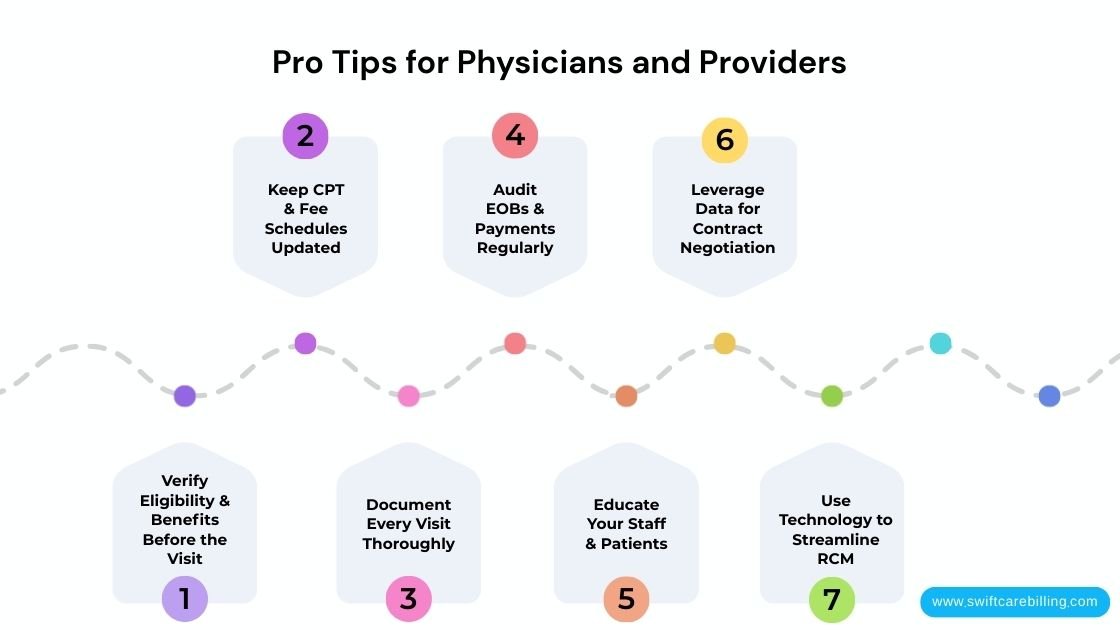
1. Verify Eligibility & Benefits Before the Visit
- Always check the patient’s coverage, deductible, copay, and coinsurance before they see you.
- Confirm in-network vs. out-of-network status to prevent surprise bills and unpaid balances.
- Use payer portals or eligibility verification tools to save time and reduce claim rejections.
2. Keep CPT & Fee Schedules Updated
- Track allowed amounts across all payers; insurers update rates annually or quarterly.
- Cross-check your billing software against contracts and posted fee schedules.
- Accurate rates prevent underpayments and reduce denials.
3. Document Every Visit Thoroughly
- E/M and preventive service documentation must justify billed CPT codes.
- Include history, exam, assessment, plan, and time spent (if billing time-based).
- Good documentation reduces denials and supports audits.
4. Audit EOBs & Payments Regularly
- Compare insurer payments with your allowed amounts.
- Track discrepancies or recurring underpayments by payer and service.
- File appeals promptly to recover missed revenue.
5. Educate Your Staff & Patients
- Train staff to explain allowed amounts, copays, and coinsurance to patients.
- Avoid confusion between billed charges and insurer-approved payments.
- Clear communication reduces patient complaints and improves collections.
6. Leverage Data for Contract Negotiation
- Use historical allowed amount data to negotiate better rates with payers.
- Identify CPT codes with large gaps between billed and allowed amounts.
- Set realistic cash-pay rates based on insurer-approved reimbursements.
7. Use Technology to Streamline RCM
- Practice management software and RCM tools can automate claim submission, track denials, and manage allowed amounts.
- Real-time dashboards help monitor revenue, AR, and patient balances efficiently.
Conclusion
A Primary Care Physician is more than just a doctor — they are the backbone of your healthcare system, providing preventive care, chronic disease management, and care coordination. From a billing and RCM perspective, PCP visits are central to practice revenue, allowed amounts, and insurance compliance.
For patients, a PCP ensures continuity of care, better health outcomes, and lower costs. For providers, understanding allowed amounts, claim submission, and E/M coding ensures that every visit is reimbursed correctly, that denials are minimized, and that cash flow remains healthy.
Get Paid What You Deserve — Without the Headaches
Billing Primary Care Physician services doesn’t have to be a headache. With Swiftcare Billing, you can:
- Track allowed amounts accurately for all payers
- Submit claims with zero errors
- Reduce denials and speed up reimbursements
- Educate patients on their financial responsibility
Take control of your practice revenue today — partner with Swiftcare Billing and ensure every PCP visit is fully optimized for payment.