



Managing the complexities of wound care billing can be particularly difficult in the field of healthcare revenue cycle management (RCM). To guarantee correct reimbursement and preserve financial viability, healthcare professionals need to be aware of a number of difficulties in billing coding and reimbursement.
Wound Care billing requires proper documentation, claims submission, prior authorization and coding for reimbursements. Accurate coding is very important for proper reimbursement. The two examples of wound care operations are debridement and wound closure that require right CPT codes for proper billing. Similarly, for supplies, equipment and wound dressings, HCPCS codes are used for correct billing.
Modifiers carry huge significance in accurate claim processing and reimbursement. It is important to use them correctly and complete paper work accurately for successful receiving of payments form insurance and clearing the entire bill. Compiling and preceding each step of billing with precision leads to proper clearing of bills.
There are a lot of minor things in medical billing that needs accuracy as they become the cause of billing errors. Efficient use of technology also helps in maximizing reimbursements. A lot of quality software are available for medical billing that make the procedure easier. Other than this, paying attention to payers policies is also very important to avoid fines and ensure timely reimbursement of wound care therapies. Healthcare providers can maintain effective and legal billing procedures while offering equitable service reimbursement by implementing these practices.
In order to help healthcare organizations succeed with RCM, we’ll examine some typical wound care billing mistakes in this blog and offer advice on how to prevent them to get revenue cycle management success.
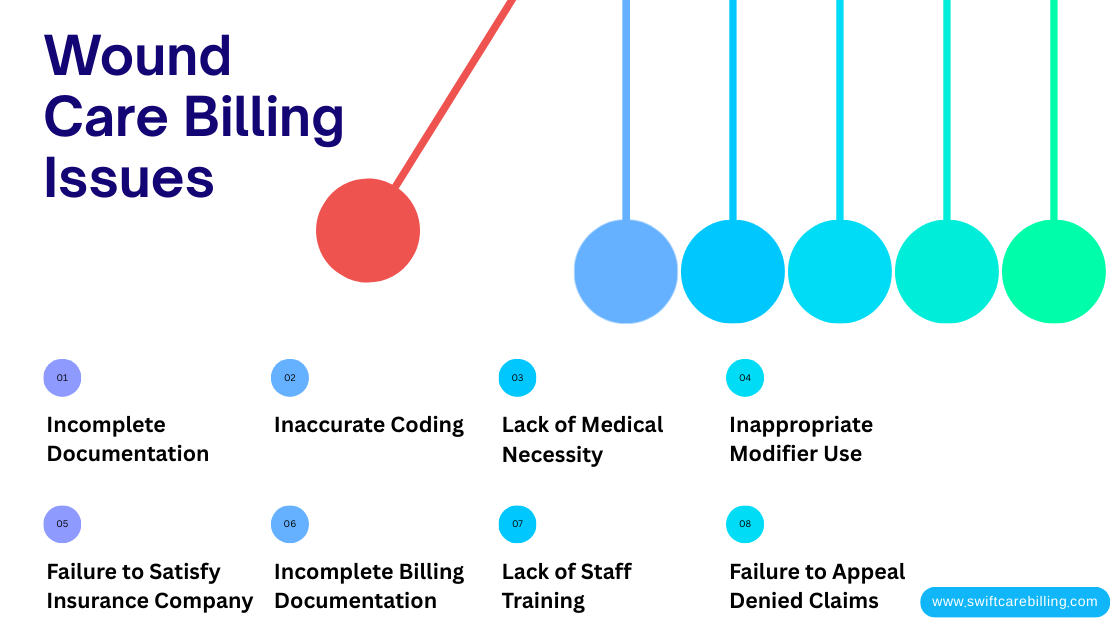
Incomplete Documentation:
Inadequate documentation is one of the biggest problems with wound care billing. In the billing procedure of wound care, healthcare personnel should ensure that wound size, location, depth, and any related concerns must be clear to prevent challenges in the reimbursement procedure. Precise documentation of wound assessments, treatment details and progress notes are required for billing along with proper coding.
Inaccurate Coding:
Wound care procedures are complex that leads to coding errors. Healthcare providers need to stay updated with the updated codes and they also need to go in detail of the treatment, wound size and must write detailed notes to help insurance companies in proceeding with the payments. Coding depends on the exact treatment provided to reduce coding errors.
Lack of Medical Necessity:
The inability to prove medical necessity is another frequent mistake in wound care billing. Insurance payers require documentation demonstrating the medical necessity of wound care services, such as evidence of chronicity, severity, and failure previous treatments. Healthcare professionals should ensure that every wound care treatment is supported by comprehensive documentation in order to avoid rejections due to lack of medical necessity.
Inappropriate Modifier Use:
Modifiers are commonly utilized in wound care billing when paying for several treatments or services provided during a single interaction. Most of the time, wound care billing face the problem of reimbursement due to incorrect coding and inappropriate use of modifies. Detailed documentation and using correct codes and modifiers help in clearing bills.
Failure to Satisfy Insurance Company:
Checking patients’ eligibility is important before providing wound care services as its billing is complex and may result in claim denials and payment delays. It is advised to verify coverage for wound care services before providing the treatment and write detailed notes related to wound treatments and sessions required to reduce the likelihood of billing errors and denials.
Incomplete Billing Documentation:
As billing documentation requires a lot of minor details that include complete name, insurance policy number, treatment details and the list carries a lot more information. Any of the missing and inaccurate information leads to claim rejection therefore, making sure that data is properly recorded with each detail and then proceed.
Lack of Staff Training:
Provide proper training to wound care billing employees and insufficient knowledge will cause a problem of payments delays and rejections of claims. They must be able to record services given to the patients properly to reduce the risk of billing errors. Continuous training session must be given to them to keep billing smooth.
Failure to Appeal Denied Claims:
In wound care billing, claim denials can still happen despite best efforts. However, the appeals process allows for the reversal of many denials. In order to support refused claims and obtain reimbursement, healthcare organizations should have a systematic procedure for appealing them as soon as possible. Moreover, attachment of proof further helps.
Conclusion:
Wound care billing requires attention to detail that involves proper documentation, prior authorization, writing complete detail of treatment provided, proper coding and use of correct modifiers to prevent any problem. If healthcare practitioners take care of all these things they can make their billing smooth. Proper training to employees is important to achieve the targeted outcomes.
SwiftCare Billing, a pioneer in healthcare revenue cycle management solutions, is aware of the particular difficulties healthcare professionals encounter while invoicing for wound care. Our all-inclusive array of RCM services and technologies is made to maximize reimbursement, simplify billing procedures, and reduce the possibility of typical mistakes. SwiftCare Billing cutting-edge technology and industry knowledge enable healthcare organizations to increase documentation accuracy, guarantee payer and code compliance, and optimize revenue potential. Healthcare providers can improve their RCM success in wound care billing by collaborating with SwiftCare Billing, which will promote operational effectiveness and financial stability.