



The process of verifying patients’ insurance is frequently seen as an administrative step, check if the patient’s insurance is up to date, then proceed. The practical implementation of an insurance eligibility process includes a number of checks, all of which are linked to a patient’s registration and the information from the patient’s payer, his/her benefits, the need for services, and the documentation required.
The goal isn’t just to establish if a patient has insurance coverage. It’s to determine if the patient’s coverage is in effect for the date of the planned service, if that service is covered under the patient’s benefits plan, and if there are additional requirements that could impact the encounter’s billing.
Where the Verification Process Begins
The process begins prior to an inquiry to the payer to determine eligibility. The data entered at registration will be used to determine the identity of the member payee.
Staff should confirm with the patient the legal name, date of birth, member ID, the group number (if applicable), the subscriber information, relationship to the subscriber, the payer name, and the effective coverage dates. Any slight difference can cause an electronic response to not match the patient.
Accurate registration is the first check point in the patient insurance eligibility verification process. Paying the member repeatedly will not give a reliable answer if the member ID is entered incorrectly (e.g. you pay with the member ID but it is wrong).
Additional information should have been compared with the patient’s insurance card or other information provided by the patient. If a patient notifies a new health care provider or health plan, the old insurance policy cannot just continue to pay the claim as the primary plan.

Step 1: Identify the Coverage to Be Verified
The first step is to identify specific things to inspect. Requirements for benefits may vary for a regular office visit, diagnostic testing, consultation with a specialist, or continued care for a treatment.
For instance, an established-patient office visit that is to be documented as CPT 99213. The verification team might need to clarify if the plan is active, if the provider is an in-network provider, what office visit benefits are available and what portion of cost, if any, might be assigned to the patient.
The mere fact that a service is covered doesn’t necessarily mean it’s covered by the CPT code. Rather, it names the proposed service, allowing the verification team to inquire of the insurance company about the benefits. This is important, as the insurance eligibility check process should not be done as a generic policy lookup process, but it should be tied to the appointment.
Step 2: Send the Eligibility Inquiry
After patient/payer data is verified, the inquiry can be sent via the verification method chosen. This can be through a payer portal, clearinghouse, practice management system, or electronic eligibility connection, depending on the organization and payer.
The standard for the HIPAA-covered electronic transactions is the ASC X12N 270/271 transaction. Eligibility inquiry is 270 and the payer’s response is 271. According to CMS, these transactions are employed to gain insight into an enrollee’s coverage status and eligibility, such as financial information and coverage for particular types of services.
CMS’s HETS system can facilitate real-time 270/271 Medicare eligibility transactions. HETS can be used to verify Medicare beneficiary eligibility and beneficiary liability, and eligibility for certain services.
Step 3: Read the Response Instead of Just Looking for “Active”
An eligibility response can contain considerably more information than a simple active/inactive status.
A useful insurance eligibility verification process reviews the response for:
- Coverage effective and termination dates
- Plan or product information
- In-network and out-of-network benefits
- Deductible and remaining deductible
- Copayment and coinsurance
- Benefit limitations
- Service-specific coverage
- Primary or secondary payer information
- Referral or authorization requirements when indicated
CMS’ eligibility operating rules mandate that health plans provide real-time data that may include coverage of certain types of services, deductibles, copayments, coinsurance and network differences.
For instance, a positive response to the query that the policy is in effect does not necessarily mean that the patient would not be responsible for any costs. There may be an unmet deductible or coinsurance liability for the planned service.
Step 4: Match Benefits to the Scheduled Service
In this step the verification becomes useful over just coverage. Think about a patient who is coming in for an office visit, CPT 99213. The group might find that the plan is in effect, but the patient still has a deductible to pay. A second patient might be charged a copayment on the same service since the deductible has already been met.
However, in some other medical visits for abdominal pain, the provider may end up documenting only ICD-10-CM R10.9 (Unspecified abdominal pain) and the correct procedure or evaluation code. The diagnosis code is usually not the focus of an eligibility check, but rather a part of the claims reporting process. It is important, therefore, to not consider it as having already determined medical necessity through an eligibility response. The important thing is to know what to include in the eligibility process and where to include it later on during coding and claims submission.
Step 5: Investigate Exceptions
Not every electronic response will produce a clean result. If there is incomplete, inactive or conflicting information at the patient eligibility verification phase, there needs to be a defined process for how to handle that information.
Staff should see if the policy information is dated or if the patient has another coverage or if the payer returns inactive coverage. If the answer cannot be matched back to the patient, then the information in the registration should be checked before asking the question again.
Medicare HETS provides a useful example of why response codes matter. CMS states that, since May 11, 2026, HETS eligibility requests submitted by third-party vendors must contain an NPI with a current and valid HETS EDI enrollment agreement. If that enrollment is missing, HETS can return an AAA error code 41, indicating that the provider needs to complete the required HETS EDI enrollment.
This is totally different from a non-active insurance policy. Follow-up is needed for both answers, and there is a total difference in the problem.
Step 6: Record the Verification Result
The insurance eligibility verification process should result in a usable record for a complete process. A record should include time of eligibility check, payer contacted, coverage, benefit information and any issues to follow up. If a staff member contacts the payer due to a missing electronic response, the result of that phone call should also be recorded per the organisation’s procedures.
If you have professional documentation, the next employee won’t have to verify the same information and provides a reference point for the billing staff when setting up the claim.
Step 7: Reverify When Necessary
Eligibility dates are specific to a particular time. A policy that was in effect at the time of an appointment may not be in effect on the date of service.
These insurance eligibility verification steps should then be followed by a reverification in the event of a significant change. This may mean a new insurance card, a change in employer, a change in payer, extended gap in scheduling and treatment, or recurring care of a treatment with a change in coverage.
This can be included within the scheduling process so that no single individual is responsible for doing this.
Building an Efficient Insurance Verification Workflow
An effective insurance verification workflow should have clearly defined handoffs rather than leaving verification as an isolated registration task.
A practical workflow can move through five stages:
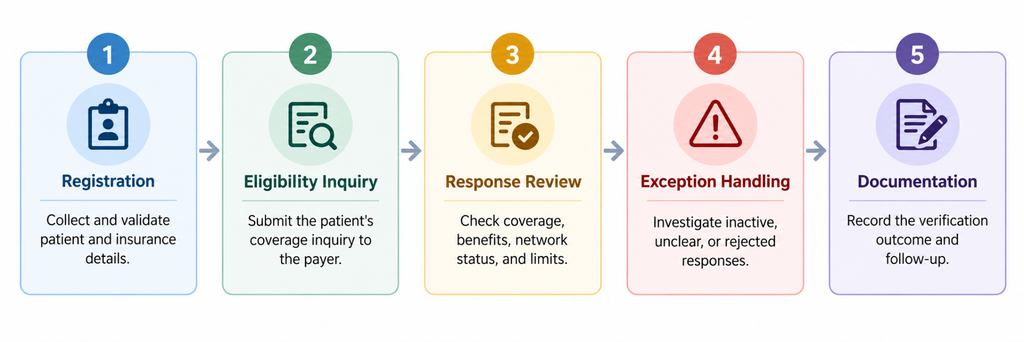
What happens between these stages is the most important. A successful response can proceed straight to appointment preparation. An inactive policy may be re-registered to obtain the latest information. Unclear benefit response can be escalated for further payer research.
This same structure allows for better performance measurement as well. Organizations can track any unresolved eligibility cases, anything that needs to be responded to, any insurance that is out of date, and the time it takes to complete the verification.
Electronic Verification in 2026
Electronic eligibility is continually changing. CMS’s HETS system is real time for Medicare 270/271 transactions, and CMS is still publishing updates to its HETS companion guides and response specs.
CMS also released a new HETS 2026-4 version due in December 2026, which may include updates to 270 requests/271 responses. Therefore, any organization that is using HETS should make sure their eligibility systems and vendor processes reflect current CMS documentation.
This is especially important when organizations are relying on third party vendors. A technically connected system is not sufficient if enrollment or NPI relationships, or transaction requirements are not properly maintained.

Best Practices for Healthcare Providers
The most effective healthcare insurance verification process is one that is standardized but still allows staff to investigate exceptions. Professional organizations ought to have a uniform check point for eligibility, uniform patient information and record the result in a common system. It is important for the verification teams to differentiate between active coverage, benefit eligibility, network participation and coverage authorization do not confuse them all.
Another good idea is not to use the insurance card as the sole identifier. The card contains helpful identifying data, but electronic eligibility or direct data from the payer may give more up-to-date coverage and benefit data that may have changed since the card was issued.
Last but not least, practices need to review failed verification cases regularly. When the same payer continues to make errors or the same type of registration error occurs with more than one patient, the issue might be with the workflow and not with patients.
When Outsourcing May Make Sense
Insurance eligibility verification process can be repetitive for organizations with hundreds or even thousands of appointments. With clear documentation, escalation, turnaround, and data security protocols, a specialized billing team can handle the patient insurance verification process at scale.
Outsourcing is best suited when it enhances an existing process instead of just passing off an undefinable task to another group. The provider should also have an ability to keep visibility on verification status and cases not resolved.
Conclusion
An effective insurance eligibility verification process is more than just checking to see if a policy exists. It links up correct registration with electronic eligibility enquiries, benefit interpretation, exception processing, documentation, and prompt re-verification.
With each stage having a clear purpose, staff can differentiate between an inactive policy and an eligibility-system error, an active policy and benefits available, and coverage information and subsequent coding and claim requirements. This clarity helps to streamline its verification process and provides healthcare practices with more information before the billing stage of the encounter.
FAQS
1. What information is checked during insurance eligibility verification?
Normally it will verify the member information, coverage status, effective dates, deductibles, copayments, coinsurance, network status, benefit limits, applicable referral or authorization requirements, and more.
2. Is insurance eligibility verification the same as benefits verification?
Not exactly. Eligibility tells if there is coverage, benefits verification offers specific data on the coverage amount and the patient’s possible cost.
3. What happens when an eligibility check returns incorrect or incomplete information?
The information must be checked for accuracy on the patient’s records and it could be necessary to re-contact the payer and/or re-submit the inquiry if the demographics/insurance information is incorrect. The answer should then be recorded for future reference.
4. Does active insurance eligibility guarantee that a medical service will be covered?
Being “active” does not necessarily mean payment. Coverage may still be subject to the terms of the service, network, benefit restrictions, and other terms and conditions of the plan.