



If you run a urology practice, you’ve seen this. A doctor documents prostate cancer. You bill it. Payer denies it for an invalid or non-specific diagnosis. Now you’re on hold for 45 minutes.
We’ve seen it hundreds of times at SwiftCare Billing. Prostate cancer looks simple on the surface. But coding it changes based on whether cancer is active, in history, or has spread. Get that wrong, and the claim doesn’t just get denied; it sticks in AR for 60 days.
So let’s walk through it in order. One logical chain. No jumping. By the end, you’ll know exactly how to use C61 and when not to.
Now let’s break down why that answer matters for billing.
Step 1: What is the C61 ICD-10 Code? The Foundation
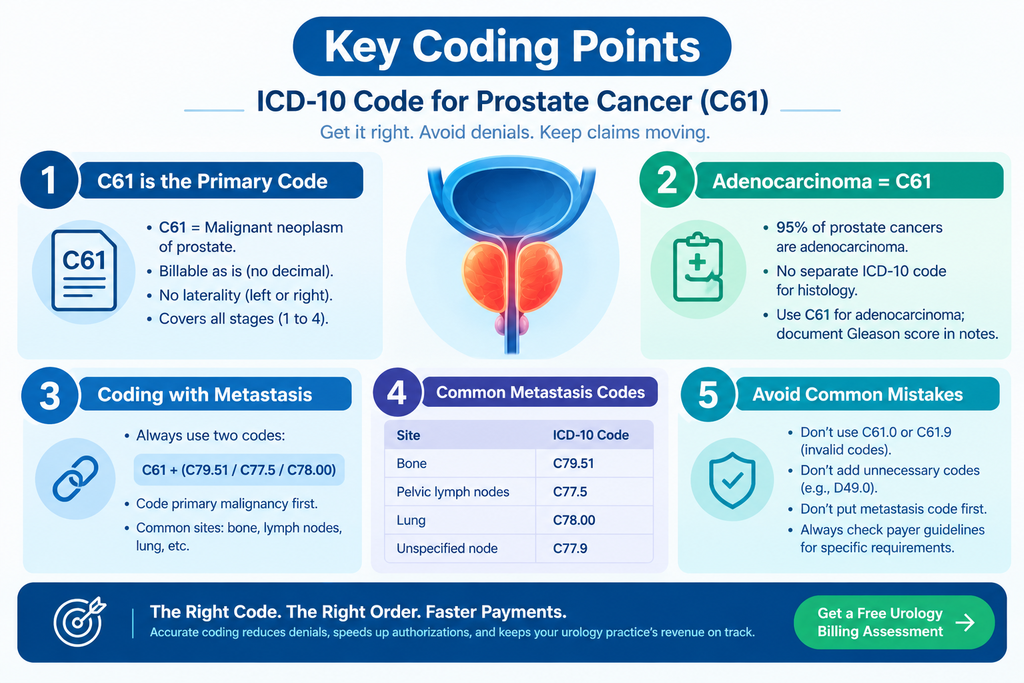
C61 ICD-10 code is defined by CDC as malignant neoplasm of prostate. That’s official wording in ICD-10-CM book.
It lives in Chapter 2, Neoplasms, under C60-C63 malignant neoplasms of male genital organs. CMS groups it there for FY 2025.
Here is what makes C61 different from other cancer codes:
First, it’s billable as is. Just C61. No decimal needed. No extra digit. Not C61.0. Not C61.9. We had a claim from a New York urology group last month denied because EHR auto-populated C61.0. There is no C61.0. The payer returned an invalid code. One digit, full denial. At SwiftCare Billing, we scrub for that before the claim goes out.
Second, it has no laterality. No left prostate or right prostate. Just C61. One less thing to worry about.
Third, it covers any primary prostate cancer, regardless of stage. Stage 1 or stage 4, primary code stays C61. Stage affects your CPT and medical necessity, not the base ICD.
So when your doctor writes prostate cancer, prostate adenocarcinoma, or malignant neoplasm of prostate, your starting point is always C61. This is your ICD-10-CM code for prostate cancer, your prostate cancer diagnosis code, your base.
Think of C61 as the foundation. Everything else we add builds on top of it.
Step 2: Prostate Adenocarcinoma ICD-10 Code – Why It’s Still C61
We get this question daily at SwiftCare Billing. The doctor’s pathology report says adenocarcinoma of the prostate. A biller asks, what is the prostate adenocarcinoma ICD-10 code? Is it different from C61?
The answer is no. It’s still C61.
Here is why. 95% of prostate cancers are adenocarcinoma. That’s histology. ICD-10 for prostate doesn’t have separate histology codes like lung does. The ICD-10 code for malignant neoplasm of the prostate is C61, and that includes adenocarcinoma.
So you don’t need to search for a more specific code. You won’t find one. C61 covers adenocarcinoma.
What should you do with pathology details? Document them in the EHR. Keep Gleason score in notes. But for billing diagnosis, use C61.
One of our clients, a urology group in Florida, was using C61 plus D49.0 for adenocarcinoma. Payer denied it for unbundling. We fixed it to C61 alone, and the denial stopped. That’s typical. Keep it simple. C61.
So to be clear: prostate adenocarcinoma ICD-10 code = C61. Prostate cancer diagnosis code = C61. Same.
Step 3: ICD-10 Code for Prostate Cancer With Metastasis – The Second Code
This is where most urology claims get stuck in AR. And it’s where SwiftCare Billing spends most of its time fixing.
Prostate cancer commonly spreads to bone. If it has spread, C61 alone doesn’t tell the full story. Payer needs to know where it spread to approve bone scan, PET PSMA, or Xgeva.
CMS Official Guideline says: Code primary malignancy first, then secondary metastasis.
So ICD-10 code for prostate cancer with metastasis is always two codes, in the right order.
Example 1: Prostate cancer with bone metastasis – most common
Patient has prostate cancer that went to bone. He has bone pain; PSA is rising.
- Code 1: C61 – Malignant neoplasm of prostate – primary site
- Code 2: C79.51 – Secondary malignant neoplasm of bone
Order matters. C61 first. If you put C79.51 first, the payer will think bone is primary and deny it as the wrong primary.
Example 2: Prostate cancer with pelvic lymph node metastasis
- Code 1: C61
- Code 2: C77.5 – Secondary malignant neoplasm of pelvic lymph nodes
Or C77.9 if unspecified lymph node
Example 3: Prostate cancer with lung metastasis
- Code 1: C61
- Code 2: C78.00 – Secondary malignant neoplasm of unspecified lung
So what is the C61 ICD-10 code with metastasis? It’s C61 + C79, C77, or C78 series.
Think of it this way. C61 answers where cancer started. C79.51 answers where cancer is now. Payer needs both to understand why you are doing advanced imaging.
At SwiftCare Billing, we check this combo before submission. We link C61 + C79.51 to CPT 78815 PET scan. If only C61 is there, the payer says the PET scan is not medically necessary. Add C79.51, and it passes. Small code, big difference in payment.
Source for this sequencing: CDC ICD-10-CM Browser and CMS 2025 ICD-10-CM Guidelines Chapter 2, Section C.7.

Struggling With Prostate Cancer Claim Denials?
Incorrect diagnosis codes and missing documentation can slow down your urology payments. SwiftCare Billing helps practices review coding errors, investigate denials, and improve claim accuracy.
Step 4: When NOT to Use C61 – Three Denials We Fix Every Week
Now you know when to use C61. You also need to know when NOT to use it. At SwiftCare Billing, we audited 120 urology claims last quarter. 18% were denied because they used C61 at the wrong time.
Denial Trap 1: Elevated PSA alone is not C61
Patient has PSA 8.2, no biopsy yet. Doctor writes elevated PSA.
Code is R97.21 – Elevated prostate-specific antigen (PSA). Not C61.
If you use an ICD-10 code for Prostate Cancer without biopsy confirming cancer, the payer will request pathology and deny for lack of medical necessity. We tell our coders, no biopsy, no C61. Use R97.21 until pathology confirms.
Denial Trap 2: History of prostate cancer is not C61
Patient had prostatectomy 3 years ago, now comes for routine PSA, no active cancer, no recurrence.
Code is Z85.46 – Personal history of malignant neoplasm of prostate. Not C61.
This is big. If you use C61 for history, the payer thinks active cancer and expects active treatment like surgery or radiation. They will deny follow-up PSA as active treatment not documented. Use Z85.46.
Denial Trap 3: BPH and screening are not C61
Benign prostatic hyperplasia is N40.0 or N40.1. Not C61.
Screening encounter with no cancer found is Z12.5 – Encounter for screening for malignant neoplasm of prostate. Not C61.
If screening finds cancer, then you switch from Z12.5 to C61 on that same encounter with pathology.
Here is the table we give to our urology billers at SwiftCare Billing:
| Clinical Situation | Correct Code | Common Mistake |
|---|---|---|
| Active prostate cancer | C61 | Using Z85.46 |
| Adenocarcinoma of prostate | C61 | Searching for separate code |
| Prostate cancer with bone mets | C61 + C79.51 | C79.51 alone |
| High PSA, no biopsy | R97.21 | C61 too early |
| History, post-prostatectomy | Z85.46 | C61 when cancer gone |
| Screening, no finding | Z12.5 | C61 without diagnosis |
Get this table right, and you avoid 80% of C61 denials.
Step 5: How to Bill Prostate Cancer Medical Billing Code and Get Paid
Having the right ICD-10 code for Prostate Cancer is only half the job. The other half is linking it to CPT so the payer sees medical necessity.
C61 alone doesn’t pay. C61 linked to the right CPT does.
Examples we bill daily at SwiftCare Billing:
- CPT 55866 laparoscopic radical prostatectomy needs C61 as primary
- CPT 77385 IMRT radiation needs C61
- CPT 78815 PET scan for prostate cancer needs C61 + C79.51 if bone mets are present, or it will be denied as not medically necessary
- CPT 55700 prostate biopsy should NOT have C61 before pathology. Use R97.21 or N40.1 for biopsy. Wait for the result, then code C61 if positive.
Two billing tips from our denial team:
First, never code C61 and Z85.46 together for the same cancer. Active and history together is an NCCI edit. The payer system will deny automatically.
Second, prior auth for C61 cases. For PET PSMA, bone scan, or advanced imaging, we include C61 plus metastasis code plus PSA level and symptoms in prior auth notes. Document rising PSA, bone pain, and prior treatment failure. Payers want a clinical story, not just code.
This is where SwiftCare Billing is different. We don’t just submit claims. We are a medical billing company that works inside your EHR, checks medical necessity before submission, and tracks every C61 denial by payer and reason. Our medical billing services for urology include eligibility, CPC coding, scrubbing against NGS edits, denial management, and AR follow-up past 30 days.
We also provide medical billing and coding services for specialty practices. So if you are a urology group billing C61 daily, we know your payer mix. NGS Medicare, Empire BCBS, Medicaid managed care. Each has slightly different rules for C61 + metastasis. We track that.
And our denial management process logs every prostate cancer medical billing code denial. If we see repeat C61 denials from the same payer, we fix the source, not just rebill the same claim.
Conclusion: Your C61 Checklist Before You Submit
Let’s bring the whole chain together so you can code C61 right every time.
- Is cancer active and documented with biopsy? If yes, the base is C61. That’s your ICD-10-CM code for prostate cancer.
- Is pathology adenocarcinoma? Still C61. The ICD-10 code for prostate adenocarcinoma is C61.
- Has it spread? If yes, add a second code. ICD-10 code for prostate cancer with metastasis is C61 + C79.51 for bone, C77.5 for nodes, C78 for lung. C61 always first.
- Is it only high PSA? Use R97.21, not C61.
- Is it history? Use Z85.46, not C61.
- Is the code exactly C61, not C61.0? Good to go.
Follow that order, and your ICD-10 code for Prostate Cancer claims will go clean. Mess up the order, and you chase denials for weeks.
Ready to Reduce C61 Denials and Recover Delayed Revenue?
If your AR is sitting over 60 days because of C61 denials, let us look. SwiftCare Billing offers a free 90-day denial audit for urology practices. We work inside your EHR, no migration, and show you where money is stuck. You keep your data. No long-term contract.
That’s how a reliable medical billing company for specialty practices should work.
FAQ
A: The ICD-10 code for prostate cancer is C61. It’s the ICD-10-CM code for prostate cancer used for active malignant neoplasm of the prostate. C61 is billable and valid for FY 2025-2026 per CMS.
A: The C61 ICD-10 code is used for active malignant neoplasm of the prostate, including adenocarcinoma. C61 ICD-10 code covers all primary prostate cancers. Use it for active cancer, not for history or elevated PSA alone.
A: For prostate cancer with metastasis, code C61 first, then the secondary code. Use C61 + C79.51 for bone metastasis, C61 + C77.5 for pelvic lymph nodes. C61 is always primary. Never code C79 alone.
A: The ICD-10 code for prostate adenocarcinoma is C61. ICD-10 doesn’t have separate code for adenocarcinoma histology of the prostate. C61 covers all primary prostate cancers, including adenocarcinoma.
A: Yes, C61 is billable. ICD-10 code for malignant neoplasm of prostate, C61, is valid and billable without additional digits. Don’t use C61.0 or C61.9.
A: For screening, use Z12.5. For active diagnosis, use C61. For history after treatment, use Z85.46. Don’t mix screening and active diagnosis codes for the same encounter.