



Headaches are among the most frequent complaints of patients seeking healthcare from primary care physicians, neurologists, urgent care centers, and others. Some cases are only temporary but others may need to be further investigated to determine if there is a neurological cause to the pain.
To diagnose, properly treat and bill for headache symptoms, physicians must be able to identify and document these symptoms accurately. The wrong diagnosis code can misrepresent the patient’s condition, cause claim processing problems or even result in the need for further documentation. When the headache is not specified, the ICD-10 Code for Headache is R51.9. But there are codes for migraine, tension-type headache, cluster headache and other types of headache diagnosed.
This guide outlines the FY 2027 diagnosis codes, clinical documentation, coding examples, and billing considerations, to ensure accurate claims are submitted.
What’s New for Headache Coding in FY 2027?
The ICD-10-CM code set for FY 2027 will be effective from 10/01/2026 to September 30, 2027. Meanwhile, codes like G43. are used for unspecified headaches, and R51.9 is reserved for any other headache.E09 persists in differentiating chronic migraine with aura from other types of migraine.
It is crucial to note that some of the codes in the R51, G43, and a few of the G44 subcategories are not fully billable codes for practices. The right specific code is required for claims. Healthcare providers should not rely on an outdated list of coding but rather the FY 2027 release.
Official reference: CMS ICD-10-CM Codes and Updates
Common Headache ICD-10 Codes for 2027
The following headache icd 10 reference table covers frequently documented headache diagnoses.
| Headache diagnosis | ICD-10-CM code |
|---|---|
| Headache, unspecified | R51.9 |
| Headache with orthostatic component, NEC | R51.0 |
| Migraine without aura, not intractable, without status migrainosus | G43.009 |
| Migraine with aura, not intractable, without status migrainosus | G43.109 |
| Chronic migraine without aura, not intractable, without status migrainosus | G43.709 |
| Chronic migraine with aura, not intractable, without status migrainosus | G43.E09 |
| Tension-type headache, unspecified, not intractable | G44.209 |
| Chronic tension-type headache, not intractable | G44.229 |
| Episodic cluster headache, not intractable | G44.019 |
| New daily persistent headache | G44.52 |
The different codes are for various clinical conditions. Doctors should be sure to make a clear diagnosis in order for the medical coder to be able to choose the right classification.
ICD-10 Headache Unspecified: When Should R51.9 Be Used?
The term icd 10 headache unspecified refers to headache symptoms that have not been attributed to a specific diagnosed headache disorder.
R51.9 may be appropriate when:
- The patient is being evaluated for headache symptoms for the first time.
- During the visit, the doctor is not able to make a specific diagnosis of a headache.
- Additional investigations are required to determine the cause.
- The clinical documentation reports headache without additional classification.
Can R51.9 Be Used as a Primary Diagnosis?
Yes. If the patient’s primary problem is headache and no more specific diagnosis has been made, the diagnosis of R51.9 may be given as the first diagnosis in the consultation. Generally, suspected, probable, and rule-out codes may not be used as confirmed codes for outpatient coding.
For example, if a doctor looks into the possibility of migraine, but does not diagnose it, the symptom of headache may be reported. This is in line with the ICD-10-CM outpatient coding guidelines.
Migraine ICD-10 Codes: Understanding the G43 Category
Migraine is a neurobiological condition characterised by recurrent patterns of headache attacks, which are sometimes accompanied by nausea, light and sound sensitivity and can sometimes cause an aura. The icd 10 classification for migraine is G43, where the code will vary depending on the type of condition that has been diagnosed and the severity of the condition.
Four details are particularly important for coding:
- Aura: Does patient get reversible neurological symptoms from migraine.
- Chronicity: Yes/No (clinical presentation meets chronic migraine criteria).
- Intractability: Difficulty in control with proper treatment.
- Status migrainosus: If a prolonged migraine attack fulfills the appropriate clinical conditions.
Physicians should document these characteristics when established rather than expecting the billing team to determine them from treatment history alone.
Common Migraine Coding Examples
| Documented diagnosis | ICD-10-CM code |
|---|---|
| Migraine, unspecified, not intractable, without status migrainosus | G43.909 |
| Migraine without aura, not intractable, without status migrainosus | G43.009 |
| Migraine with aura, not intractable, without status migrainosus | G43.109 |
| Chronic migraine with aura, intractable, without status migrainosus | G43.E19 |
A physician’s final diagnosis should support the selected code. The absence of documentation should not be interpreted as confirmation of a particular migraine subtype.
Chronic Migraine ICD-10: Clinical Criteria and Documentation
Chronic migraine is not just ‘a headache that happens often’. The International Classification of Headache Disorders, Third Edition (ICHD-3), provides a general definition of chronic migraine as headaches occurring on 15 or more days per month for 3 months or longer, with 8 days or more per month having migraine features and other criteria also being met.
For chronic migraine icd 10 classification:
- G43.7- covers chronic migraine without aura.
- G43.E- covers chronic migraine with aura.
Both categories require additional characters to identify the complete billable diagnosis.
What Should Physicians Document?
Record the frequency of headaches, how long it takes for the attacks, what symptoms are associated with a headache attack, whether or not there are any auras, the treatment history, whether the treatment works or not, and the final diagnosis. Headache diary can aid in establishing frequency and treatment response.
This information is especially important when asking for permission for pro-active interventions. Certain insurance carriers will need records of previous treatments and the numbers of headache days each month. The diagnosis code does not imply the eligibility for a specific treatment.
Clinical reference: International Headache Society — Chronic Migraine
Chronic Headache ICD-10: Understanding Different Conditions
Chronic headache refers to persistent or recurring headaches, but it is not a diagnosis. The correct chronic headache icd 10 code will depend on the disorder determined by the physician.
| Diagnosed condition | ICD-10-CM code |
|---|---|
| Chronic tension-type headache, not intractable | G44.229 |
| Chronic tension-type headache, intractable | G44.221 |
| New daily persistent headache | G44.52 |
| Chronic post-traumatic headache, not intractable | G44.329 |
| Chronic cluster headache, not intractable | G44.029 |
If the documentation only specifies chronic daily headache and does not specify a more definite diagnosis, or a coding index or record does not lead to a more specific diagnosis, then R51.9 may be used. All physicians should not rule out migraine as the cause of a regular headache.
Medication-Overuse Headache: An Important Coding Consideration
In the assessment of patients who come to the clinic with frequent headaches and are frequent users of acute headache medications, medication-overuse headache is of specific importance.
IHD-3: headache that occurs on ≥15 days per month, in a patient with a headache disorder, who uses acute headache medications regularly for ≥3 months. The limit of dosage varies from medication to medication. Doctors should make it clear, what medicines are taken, how often, for how long and the diagnosis confirmed.
Some people can have chronic migraine and medication-overuse headache. When both conditions are present, the patient’s condition is to be coded as per ICD-10-CM coding guidelines and medical documentation.
Clinical reference: International Headache Society — Medication-Overuse Headache
How to Select the Correct ICD-10 Code for Headache
Selecting an accurate diagnosis code requires both clinical information and coding verification. Physicians and billing teams should follow a consistent process
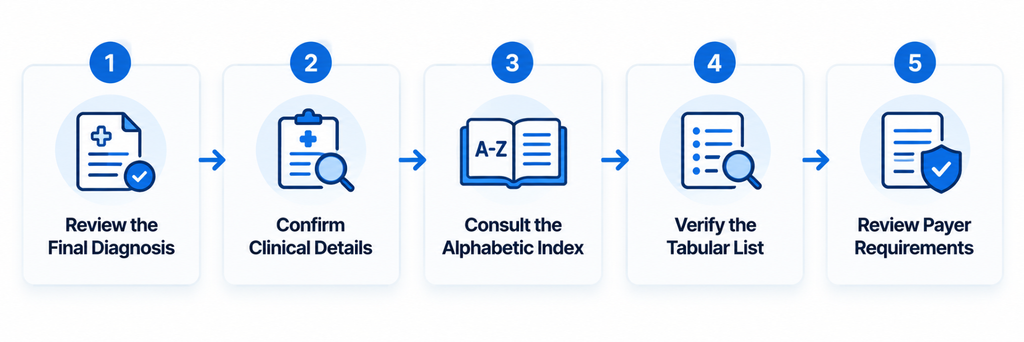
When documentation is incomplete or contradictory, a provider query may be necessary. Medical coders should not independently diagnose conditions or infer clinical details that the physician has not established.
Common Headache Coding Mistakes That Affect Claims
- Missing Migraine Details
- Submitting Incomplete Codes
- Coding Suspected Conditions as Confirmed
- Assuming the Diagnosis Code Guarantees Coverage
- Using Unspecified Codes When a Diagnosis Is Established
Practical Coding Examples for Medical Practices
Case 1: Headache Without a Confirmed Diagnosis
A patient presents with recurring head pain. After examination, the physician orders further investigations without establishing a specific headache disorder.
Possible code: R51.9
Case 2: Migraine Without Aura
A neurologist diagnoses migraine without aura, not intractable, and without status migrainosus.
Possible code: G43.009
Case 3: Chronic Tension-Type Headache
A physician documents chronic tension-type headache, not intractable, after reviewing the patient’s symptoms and headache history.
Possible code: G44.229
These hypothetical examples demonstrate coding principles. Actual claims require review of the complete medical record.
Best Practices for Accurate Headache ICD-10 Coding
ICD-10 coding for headaches is done based on detailed clinical documentation. Providers are supposed to document information about the type of headache, its location, the duration, severity, presence of associated symptoms, and recurrent nature of the condition when relevant. This will assist the billing department in selecting an appropriate diagnosis code reflecting the provider’s diagnosis and not a general code for headaches when there is a specific one in the medical records.
Practices need to update themselves on coding changes and policies of payers with regard to headache diagnosis. Before filing the claim, it is recommended that the billing department checks the diagnosis code to be sure that the diagnosis code reflects the medical records and services offered. Such coding audit practices will prevent claim denials and improve medical billing for headaches.
Final Thoughts
Selection of an appropriate ICD-10 code for Headache depends on thorough clinical assessment, good documentation practice, and the guidelines for coding as per ICD-10 standards. An accurate diagnosis is critical from the point of view of the physician as he/she needs to offer continuity in care and also distinguish among the many similar types of headaches. This will help in billing as well.
The medical billers can reduce unnecessary mistakes through code specificity, payer criteria and response analyses. SwiftCare Billing manages healthcare practices billing processes through medical coding, claims management, denial management and revenue cycle management services.
Frequently Asked Questions
The diagnosis code for headache, unspecified is R51.9. It is billable if documented by clinical care.
It is the presence of headache symptoms, but no more specific headache disorder is found.
Migraine falls under the diagnosis of G43. The entire code is based on the documented migraine subtype and other clinical details.
However, there is no code for all chronic headaches. The correct code will depend on the condition that the physician has diagnosed.
Yes, in an outpatient encounter where the headache is chiefly responsible for the services and no more definitive diagnosis has been established.