



A medical practice does not always lose money because of a major billing problem. Sometimes, it happens because of one small coding mistake that keeps showing up on claim after claim.
If you are getting denials that say CO 50: Non-covered service due to lack of medical necessity or CO 4: Modifier inconsistent, this post is for you.
A clinic was audited last month. It was a busy OB GYN practice with 3 doctors. Their denial rate was 28%. After reviewing 50 denied claims, 41 of them were caused by basic coding issues. Things that should have been caught before the claim even went out.
Let’s talk about them so you don’t make the same mistakes.
1. Modifiers: The Biggest Headache
Modifiers cause more denials than almost anything else. You can have the perfect CPT and the perfect ICD 10, but if you forget a 25 or a 59, you’re done. Claim denied.
The classic example? A patient comes in for a routine checkup and also complains about heavy bleeding. The doctor does an exam and also performs a procedure on the same day. If you bill the E/M visit and the procedure without modifier 25 on the E/M, the payer will just bundle the visit and pay you zero for it. They’ll say the visit was part of the procedure.
And don’t get started on modifier 59. Everyone uses 59 like a magic fix. It’s not. Payers now want XU, XS, XP, and XE. If you use 59 when you should use XS, many payers like Anthem and United will deny it straight away.
How this gets fixed:
There is a hard rule. No claim with two CPTs on the same day goes out without a second set of eyes on the modifiers. The claim is also run through the NCCI checker. It takes 30 seconds and saves hours of rework.
2. The Upcoding and Downcoding Trap
This one is tricky because people do it with good intentions.
Upcoding is when you bill a Level 5, such as 99245 or 99215, when the note only supports a Level 3. Maybe the doctor spent 40 minutes but only documented 2 HPI elements and a straightforward decision. You can’t bill a 5. If you do, that’s not just a denial. That’s an audit risk.
Downcoding is what scared coders do. They see a perfect Level 4 note, but they bill a Level 3 because they are “being safe.” You just lost $60 to $80 for no reason. Do that 100 times a month and you get the math.
The fix?
Stop coding from habit. Code from the note. If the note is weak, send it back to the doctor. A simple query sheet can help:
“Dr. Smith, can you clarify MDM complexity? No diagnosis was documented for the ultrasound.”
Most doctors actually appreciate it.
3. Unbundling: When You Bill Two Things That Should Be One
This is a very common medical coding mistake.
Let’s say you do a hysteroscopy with a biopsy. Some new coders will bill 58558, hysteroscopy with biopsy, and 58555, diagnostic hysteroscopy. You can’t do that. The diagnostic service is already included in the surgical hysteroscopy.
Payers have software that catches this in 0.2 seconds. You’ll get a denial saying “bundled” or “inclusive.”
4. Diagnosis That Doesn’t Match the Procedure
This is the number one reason for “medical necessity” denials. And this is where a lot of incorrect medical coding happens.
Think about it from the payer’s view.
You are billing them for a fetal biophysical profile 76819. Why? If you link it with Z34.90, routine pregnancy, they will deny it. Routine pregnancy doesn’t need a biophysical profile.
But if you link it with O36.4XX0, maternal care for intrauterine growth restriction, now it makes sense. It is medically necessary.
This happens all the time with labs, ultrasounds, and injections.
5. Old Codes: The January and October Problem
CPT codes change on January 1st. ICD 10 codes change on October 1st. Every single year.
Claims still go out in February with deleted codes from the previous year. Of course they get denied as “invalid code.”
Your clearinghouse should catch it, but sometimes it doesn’t.
Just update your system. That’s it.
6. Wrong Units
This is such a simple error, but it costs a lot.
If a code says “per 15 minutes” and you did 60 minutes, you need 4 units. If you put 1 unit, you are underbilling by 75%.
Same with drugs. J codes are based on mg. If J1050 is 50 mg and you gave 150 mg, you need 3 units.
Before you submit, ask:
Is this a time based code?
Is this a dosage based code?
Here are the usual places where units go wrong:
• Timed psychotherapy and PT codes: 90837, 97110. People always mess up the units.
• Drug J codes: Injections like Depo Provera and Rho(D) immune globulin.
• Anesthesia and obstetric global care: Not understanding what’s included in the global package.
7. Bad Documentation: The Root Cause of Everything
At the end of the day, coders can’t create codes out of thin air.
If the doctor writes, “came for checkup, ultrasound done, patient fine,” what is there to code?
There’s no detail. No laterality, no measurements, no medical decision making.
So the coder guesses. And guessing leads to medical coding errors and claim denials.
Fix your documentation first.
A small change made for one client involved adding a 4 line template for ultrasounds:
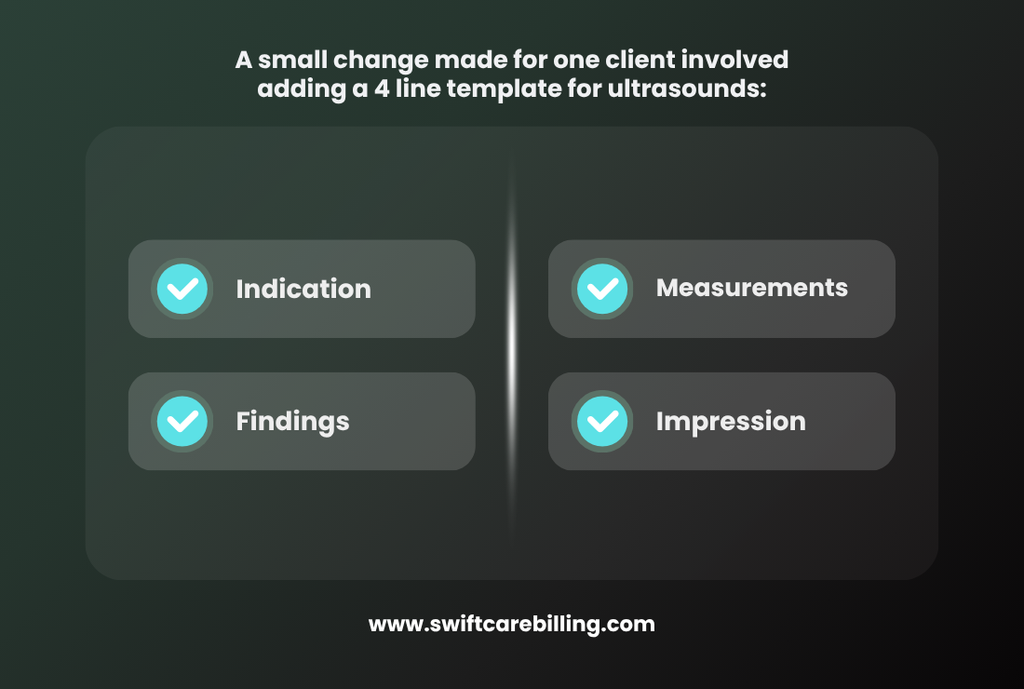
Indication
Findings
Measurements
Impression
Their denial rate dropped from 19% to 6% in 45 days. Same coders, just better notes.
Let’s Look at This Clearly
This table was created for a billing team. Maybe it will help you too.
| Error Type | What Happens on Payer Side | Denial You Will Get | Simple Fix That Works |
| Wrong Modifier | System thinks you billed a duplicate | CO 4 Modifier Missing | Run NCCI check and use XS or XE instead of just 59 |
| Unbundling | Sees two codes that are one procedure | CO 97 Bundled Service | Learn comprehensive versus component codes |
| Diagnosis Mismatch | Doesn’t see medical necessity | CO 50 Non Covered | Link the highest specificity ICD 10 and avoid Z codes for sick visits |
| Old or Invalid Code | Code is no longer in their database | CO 16 Invalid Code | Update your encoder every January 1st and October 1st |
| Wrong Units or Quantity | Quantity doesn’t match the description | CO 163 Wrong Units | Read the code description and check whether it is per 15 minutes or per 50 mg |
So How Do You Actually Stop These Errors? My Real World Checklist
This is the part about how to prevent medical coding errors and medical coding denial prevention that actually works. Not theory.
There is no need to do 100% audits. Nobody has time for that.
Here is what works:
Daily 10 Claim Spot Check
Every morning, a senior coder pulls 10 random claims from the previous day. 10 minutes.
The coder checks modifiers, linkage, and units.
If 2 errors with the same pattern are found, the whole team gets alerted that day.
Claim Scrubber Is Non Negotiable
Don’t send claims directly. Use a good scrubber.
A reliable scrubber should check NCCI, MUE, and LCD policies before the claim goes to the clearinghouse.
Keep a Denial Spreadsheet
It may be boring, but track it.
Column A: Denial reason
Column B: How many times
After 2 weeks, you will see that 70% of your denials are from 2 to 3 reasons.
Fix those 2 to 3 reasons and you fix 70% of your problem.
This is the core of medical coding quality improvement.
Train Your Doctors
And please, please train your doctors.
Here is what providers should hear every month:
• If you do an E/M and a procedure on the same day, document why the E/M was separate and significant. Write “separately identifiable” in your note.
• Don’t write “pain.” Write “left lower quadrant abdominal pain, 7/10, for 3 days.”
• Document time when you bill by time. “Total time 45 mins, more than 50% counseling” is a perfect sentence that saves a claim.
Final Word
Listen, coding errors in medical billing will never be 0%. Humans make mistakes.
But you can absolutely go from 20% denials to under 5% if you stop making the same 7 mistakes over and over.
Start tomorrow morning.
Pull 20 denied claims from last month. Most of them will likely fall into the buckets mentioned above.
Fix the pattern, not just the claim.
And if you are already overwhelmed and don’t have a team to do daily checks, get someone outside to do a one time audit. Sometimes you are too close to your own process to see the leak.
Want the denial tracking sheet used by the billing team? Tell us and we’ll share it.